
Ted Lasso Leadership and Style: Lessons for Modern Leaders

Deconstructing Ted Lasso Leadership and Style: Empathy over Authority
Ted Lasso leadership and style offers a useful leadership lens: replace reflexive control with habits that make better decisions possible. In practice, that means learning what is happening closest to the work, inviting dissent before a decision is final, and making expectations explicit after the discussion.
For decades, traditional corporate playbooks relied heavily on command-and-control management. Leaders sat atop rigid hierarchies, issued directives, hoarded information, and measured team value purely by short-term output.
But as executive burnout rises, leadership pipelines thin, and employee engagement falters, this outdated approach has reached its breaking point.
The business issue is not simply that authoritarian leadership feels outdated. It also slows the flow of accurate information upward. When people expect punishment or dismissal, they protect themselves by withholding bad news, avoiding ownership, and escalating problems too late for leaders to respond well.
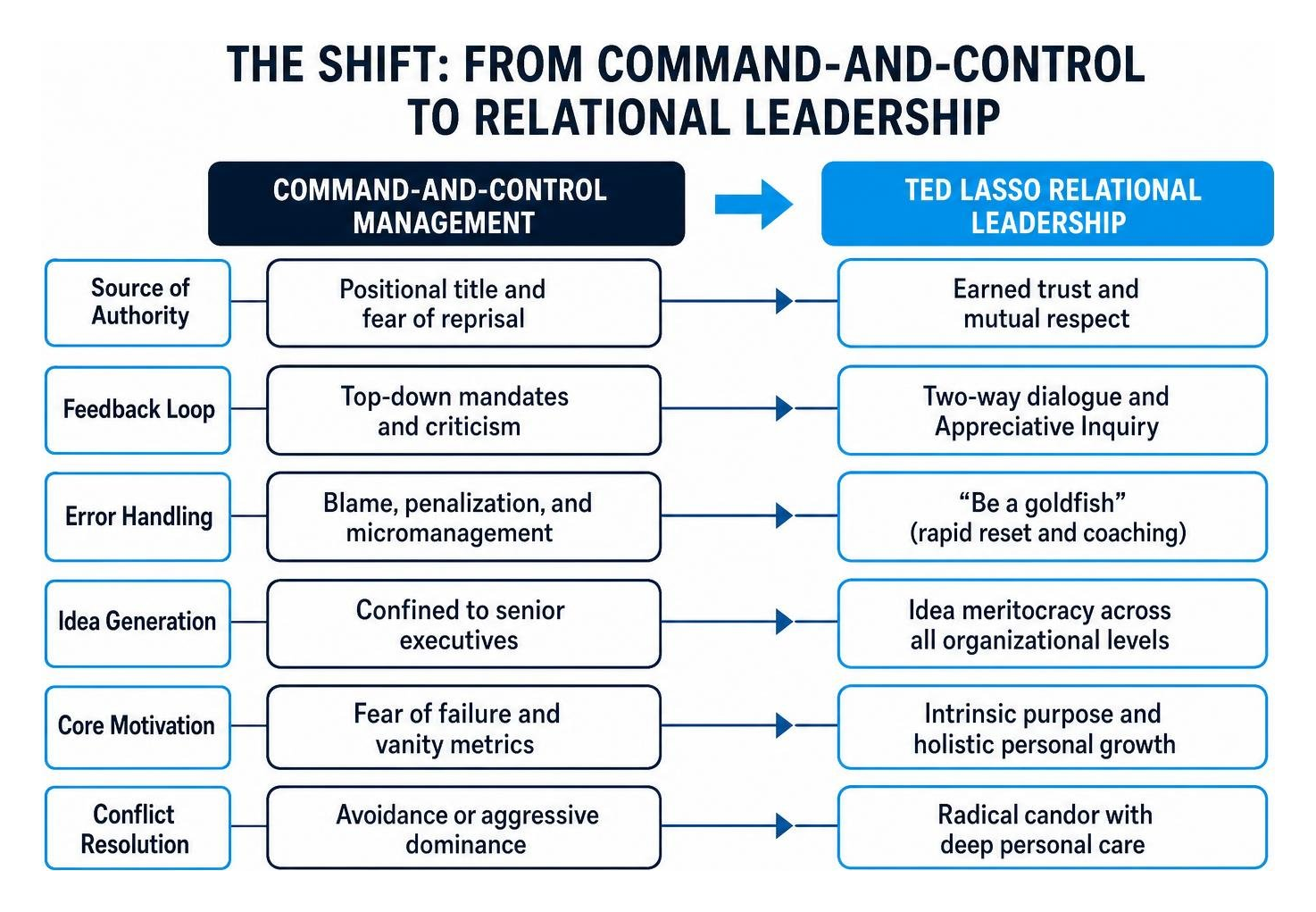
| Dimension | Command-and-Control Management | Ted Lasso Relational Leadership |
|---|---|---|
| Source of Authority | Positional title and fear of consequences | Earned trust and mutual respect |
| Feedback Loop | Top-down mandates and criticism | Two-way dialogue and Appreciative Inquiry |
| Error Handling | Blame, punishment, and micromanagement | “Be a goldfish” (rapid reset and coaching) |
| Idea Generation | Confined to senior executives | Idea meritocracy across all organizational levels |
| Core Motivation | Fear of failure and vanity metrics | Intrinsic purpose and holistic personal growth |
| Conflict Resolution | Avoidance or aggressive dominance | Radical candor with deep personal care |
Ted’s playbook exemplifies modern principles of servant leadership, proving that putting people first naturally elevates team performance. As highlighted in executive insights from WSJ, shifting the leadership dynamic from transactional oversight to genuine human connection reshapes workplace culture. Cultivating modern definitions of good leadership requires stepping away from top-down ego and creating environments where people feel seen, supported, and motivated to excel.
Psychological Safety and Relational Trust in the Locker Room
High performance cannot happen without interpersonal trust. When team members fear being humiliated or punished for speaking up, they hide errors, withhold creative solutions, and disengage. At AFC Richmond, Ted prioritizes cultivating psychological safety at work from day one.
He builds relationship bridges through deliberate, low-stakes micro-interactions—most notably his daily “Biscuits with the Boss” ritual with Rebecca Welton. While it seems like a simple gesture, baking shortbread creates a recurring, predictable touchpoint where candid conversation can happen without defensiveness.
Ted’s approach mirrors the legendary John Wooden Pyramid of Success, emphasizing that competitive greatness is built upon foundational blocks of cooperation, loyalty, and personal integrity. By intentionally investing in relationship building, leaders create an environment where calculated risk-taking is welcomed and employee voice thrives.
The Power of Vulnerability and Humility in Executive Decision-Making
Traditional leadership models often celebrate the myth of the infallible executive. Admitting you don’t know the answer is viewed as a sign of weakness. Ted breaks this archetype immediately by openly acknowledging his ignorance of soccer rules and tactical nuances upon arriving in England. Rather than hiding behind a wall of false confidence, he turns his lack of technical knowledge into a strength by inviting others to contribute their expertise.
True executive presence comes from humility and ego management. This dynamic aligns with developing emotional intelligence in leadership, where self-awareness and emotional regulation unlock authentic authority. When Ted confronts severe personal struggles and experiences panic attacks, his willingness to seek therapy with Dr. Sharon Fieldstone destigmatizes mental health challenges. By adopting a beginner’s mindset and showing his team that it is acceptable to ask for help, Ted models authentic strength that earns deep, lasting loyalty.
Core Pillars of the Lasso Way: From Goldfish Memory to Radical Candor
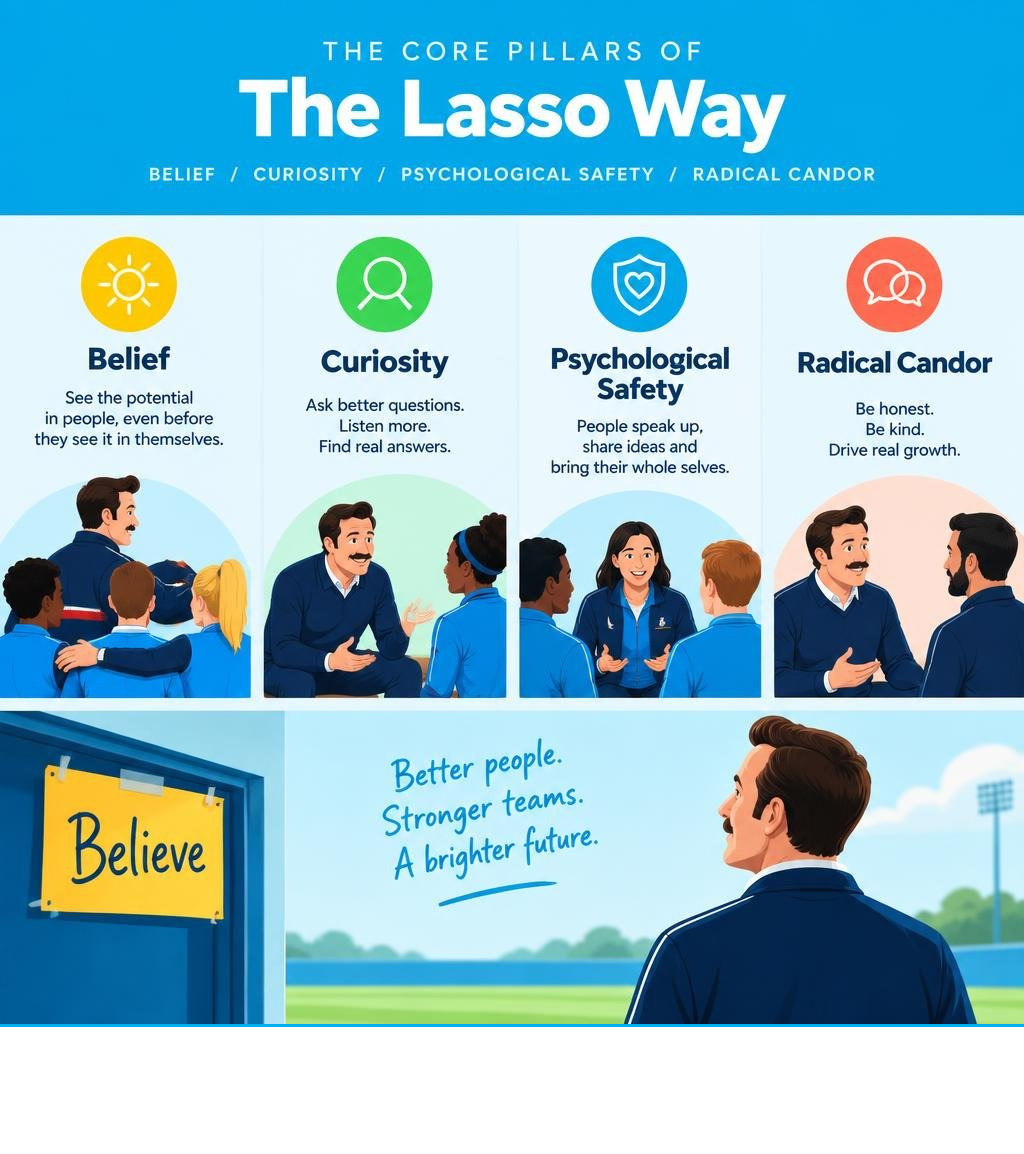
The yellow, crooked “Believe” sign is memorable because it sets a standard for how leaders interpret people’s potential. Belief alone does not improve performance; it must be paired with clear roles, specific feedback, and opportunities to practice. As IMD’s analysis of Ted Lasso and leadership notes, optimism works best as an intentional discipline rather than passive wishful thinking.
Applying Ted Lasso Leadership and Style Through Curiosity and Growth Mindsets
During a high-stakes game of darts against the former club owner Rupert, Ted shares a quote he saw painted on a wall: “Be curious, not judgmental.”
Judgment shuts down dialogue, reinforces confirmation bias, and alienates employees. Curiosity, on the other hand, opens doors to understanding root causes and unlocking creative solutions. Leaders practice this principle through intentional, non-defensive questioning and active listening. Discovering how listening improves leadership skills allows executives to uncover what genuinely motivates their teams rather than making assumptions based on surface-level behavior.
The “Yes, And” Principle: Build on Ideas Before Evaluating Them
In improvisation, “Yes, and” means acknowledging a contribution before adding to it. For leaders, the practice is not an instruction to approve every proposal. It is a way to keep useful ideas alive long enough to examine them. In a planning meeting, replace an immediate objection with: “Yes, that could address the customer concern, and we would need to confirm the budget and delivery timeline.” This response recognizes the employee’s thinking, adds practical constraints, and invites the group to improve the idea together. Used consistently, it helps teams move from defensive debate to constructive problem-solving while preserving clear decision-making standards.
Use “Yes, And” to Separate Exploration From Decision-Making
The principle works best when leaders make the meeting stage explicit. During exploration, invite people to build on an idea before judging it. During evaluation, test the strongest options against customer impact, cost, risk, and timing. A leader might say: “Yes, that could reduce the customer’s wait time, and before we commit, let’s confirm the staffing impact and define what success would look like.” This approach keeps contributors engaged while making clear that curiosity is not the same as automatic approval.
To lead with genuine curiosity:
- Pause before reacting: Replace immediate criticism with open questions such as “What led to this approach?” or “Walk me through your thinking.”
- Seek understanding over validation: Do not listen simply to prepare a rebuttal; listen to comprehend the employee’s perspective and underlying challenges.
- Practice intellectual humility: Accept that frontline employees often possess deeper operational insights into day-to-day friction points than senior leaders.
Kindness Versus Niceness: Managing Difficult Talent and Enforcing Standards
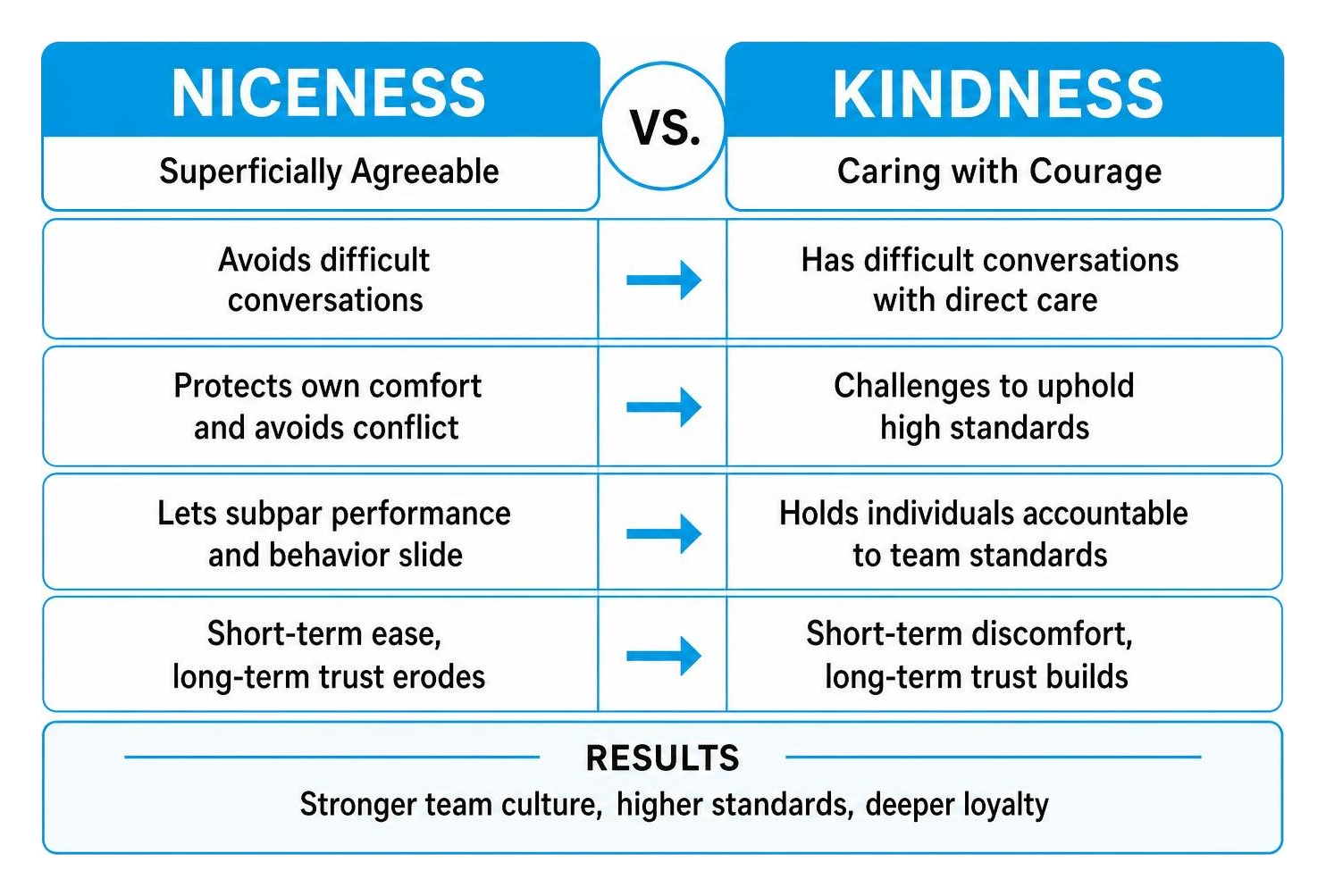
A common misconception about empathetic leadership is that it equals weakness or avoiding tough conversations. There is a profound difference between being “nice” and being “kind”:
- Being Nice: Superficially agreeable, avoiding difficult confrontations to protect one’s own comfort, and letting subpar performance slide.
- Being Kind: Caring deeply about the person while challenging them directly to meet high standards of excellence and team conduct.
Ted models this brand of radical candor when dealing with star player Jamie Tartt. Jamie is Richmond’s most talented goal scorer, but his selfish attitude and disrespect toward teammates poison team morale. When coaching, Ted praises Jamie’s innate ability while holding him strictly accountable to team standards.
When Jamie refuses to pass the ball and undermines locker room unity, Ted makes the difficult call to bench his best player during a crucial match. By navigating difficult workplace conflict examples with clear boundaries and direct care, leaders show that no individual’s ego or talent is bigger than the collective mission.
Translating the Richmond Playbook to Executive and Corporate Performance

Translating fictional sports coaching to the boardroom requires practical implementation. Executive teams operate under relentless pressure to hit growth targets, manage organizational change, strengthen succession planning, and develop leadership pipelines that can sustain performance beyond any one individual. Implementing the Richmond playbook offers a clear framework for building sustainable organizational resilience and high-performing teams, as detailed in our comprehensive guide to building high-performing teams and supported by leadership lessons from Daniels College of Business.
Idea Meritocracy: Empowering Voices Across Every Level of the Hierarchy
One of the most consequential moments in the series occurs when Ted notices Nathan “Nate” Shelley, the team’s overlooked kit man (equipment manager). While others treat Nate as background noise, Ted learns his name, asks for his strategic input on set plays, and ultimately promotes him to assistant coach.
Ted creates an idea meritocracy—a concept popularized by Ray Dalio—where the best idea wins regardless of where it originates in the organizational hierarchy.
To break down operational silos and unleash frontline innovation, consider fostering collaborative leadership across your business:
- Solve the “Water Pressure” Details: Ted’s first management action is placing a suggestion box in the locker room. When the players ask for better shower water pressure, he fixes it immediately. Solving minor, everyday operational headaches signals to employees that leadership listens and follows through on commitments.
- Establish Open Feedback Loops: Create structured, safe channels where junior staff, customer support specialists, and operations teams can pitch efficiency gains directly to decision-makers.
- Credit Publicly, Coach Privately: When Nate’s tactical play wins a game, Ted ensures the team and the press know exactly who designed it, reinforcing a culture of shared ownership and recognition.
For high-potential managers transitioning into broader leadership roles, this same approach becomes a practical coaching model: ask better questions, invite ideas from the people closest to the work, and use feedback as a development tool rather than a performance event.
Applying Ted Lasso Leadership and Style to Build a Resilient Culture
Setbacks, market shifts, and missed quarterly goals are inevitable in modern business. What separates resilient organizations from fragile ones is how leadership responds to failure.
When a player makes a game-costing error on the pitch, Ted delivers one of his most iconic coaching mantras: “You know what the happiest animal on Earth is? It’s a goldfish. You know why? It’s got a 10-second memory. Be a goldfish.”
A goldfish mindset is not permission to move on without learning. Use a short after-action review: identify what happened, separate controllable causes from external conditions, assign one owner for the next step, and agree on the date to revisit it. This turns a setback into a management decision instead of a recurring debate. Resilient leadership requires both emotional recovery and follow-through.
A 30-Day Ted Lasso Leadership and Style Action Plan
A 30-day leadership sprint gives executives a low-risk way to test whether better management habits improve execution. The aim is to turn broad ideas such as curiosity, candor, and resilience into visible actions that teams can assess and refine without creating another large-scale change program.
Days 1 to 7: Listen for friction. Hold short one-to-one conversations with direct reports and ask three consistent questions: What is making good work harder than it needs to be? Where do decisions stall? What feedback are people hesitant to share? Capture patterns rather than defending existing processes. Then resolve one credible, everyday obstacle quickly, such as an unclear approval step or a missing resource. Visible follow-through signals that employee input has practical value.
Days 8 to 14: Set a feedback rhythm. Open important meetings with a question that invites dissent, such as: What are we missing before we decide? What would make this plan fail in practice? Leaders should summarize what they heard, name the decision, and explain how feedback influenced it. This creates psychological safety while preserving accountability and decision speed.
Days 15 to 21: Coach performance directly. Choose one difficult performance or behavior issue that has been avoided. Use a simple structure: describe the specific behavior, explain its impact on the team or customer, ask for the person’s perspective, and agree on the next observable action. Care and candor work together when expectations are clear, support is available, and progress is reviewed.
Days 22 to 30: Review the signals. Assess whether meetings produce more useful ideas, whether decisions move faster, and whether managers are surfacing risks earlier. Also watch for leading indicators such as recurring team friction, employee retention concerns, missed handoffs, and reluctance to challenge assumptions. These signals do not replace formal engagement or performance measures, but they show whether trust is improving before larger business outcomes appear.
At the end of the experiment, keep the practices that produced clearer decisions or earlier risk signals and stop the rituals that did not change behavior. This prevents culture work from becoming another initiative that adds meetings without improving execution.
A chief executive or HR leader can sponsor the experiment, but the daily behavior must be owned by every people manager. Review results at the end of the month with the team: Which conversations became easier? Which bottlenecks were removed? Where do people still hesitate to speak candidly? Use those answers to choose the next management habit to reinforce rather than treating the exercise as a one-time culture campaign.
Frequently Asked Questions About Ted Lasso Leadership
What makes Ted Lasso’s leadership style different from traditional management?
Traditional management relies on positional authority, top-down directives, and transactional accountability. Ted Lasso leadership and style are rooted in servant leadership, high emotional intelligence, and relational influence. Instead of focusing solely on the scoreboard or output metrics, he prioritizes individual personal growth, knowing that holistic employee well-being naturally drives sustained, high-level performance.
How does Ted Lasso balance optimism with reality during crises?
Ted practices grounded, realistic optimism rather than toxic positivity. When Richmond faces relegation or difficult team dynamics, he does not pretend the problems do not exist. Instead, he acknowledges the harsh circumstances, addresses root causes directly through open dialogue, and provides a clear, hopeful path forward that inspires collective confidence and emotional resilience.
What is the meaning behind the ‘Be a Goldfish’ leadership philosophy?
The “Be a goldfish” philosophy encourages individuals to maintain a short memory regarding past mistakes and blunders. In executive settings, dwelling on failures breeds analysis paralysis, fear of risk-taking, and operational inertia. By performing a rapid mental reset after an error, professionals can learn the necessary lesson and redirect their focus toward the next strategic opportunity.
Conclusion

Leadership improvement does not begin with a slogan or a wholesale culture reset. It begins when leaders create reliable ways to surface concerns, make decisions, address performance, and learn from results. Over time, those routines make collaboration more useful and standards easier to uphold.
Strategy People Culture, LLC is an executive coaching and leadership consulting firm founded in 2012 by Andrew Botwin, Esq., AWI-CH, SPHR, SHRM-SCP, PCC, MBA. Drawing on more than 30 years of experience, the firm helps organizations strengthen leadership effectiveness and reduce organizational risk through executive coaching, leadership training, succession planning, workplace culture consulting, workplace investigations, and compliance training. Its work connects people strategy with business results by helping leaders build the awareness, accountability, and coaching habits needed to create healthier, higher-performing workplaces.
Executives get better results when leadership development is tied to observable choices, real conversations, and regular reflection on outcomes. This approach aligns with the firm’s mission of helping current and future leaders strengthen their businesses while building greater awareness for people and business.
Whether you are a C-suite executive aiming to align your executive team, a founder navigating rapid growth, an HR leader building a stronger leadership pipeline, or a high-potential manager learning to coach your own team, we provide tailored solutions that drive measurable business outcomes. Explore our professional executive leadership coaching to begin building a more resilient, high-performing culture today.