
A Comprehensive Guide to Disparate Impact and Employer Liability
Why Leaders Must Understand Disparate Impact and Employer Liability
Disparate Impact and Employer Liability matter because your organization can face significant legal and reputational risk even when discrimination is completely unintentional. Unlike deliberate bias, disparate impact occurs when seemingly neutral policies disproportionately harm protected groups—and leaders are responsible for identifying and addressing these hidden barriers.
Quick Overview:
- Disparate Impact: Neutral policies that create unequal outcomes for protected groups (race, color, sex, national origin, religion)
- Disparate Treatment: Intentional discrimination based on protected characteristics
- Key Legal Standard: Employers must prove policies are job-related and supported by business necessity
- Current Risk: Private lawsuits continue despite EEOC closing disparate impact investigations by September 30, 2025
- Leadership Imperative: Proactively audit policies to prevent systemic discrimination and build stronger workplace culture
The stakes are high. Walmart paid $20 million in 2020 to settle claims that physical ability tests discriminated against women. These issues don’t just create legal exposure—they erode trust, damage employer brand, and prevent organizations from accessing the full talent pool.
For business leaders, understanding Disparate Impact and Employer Liability isn’t just about compliance. It’s about building organizations where merit-based decisions actually work as intended, where your leadership team can confidently defend their processes, and where cultural strength becomes a competitive advantage rather than a legal liability.
Andrew Botwin, founder of Strategy People Culture, LLC, has helped organizations steer complex workplace culture and compliance challenges, including Disparate Impact and Employer Liability risks, by drawing on a background that bridges HR strategy, legal expertise, and executive coaching. This guide translates complex legal concepts into actionable leadership strategies that protect organizations while strengthening their cultures.
What is Disparate Impact in Employment Law?
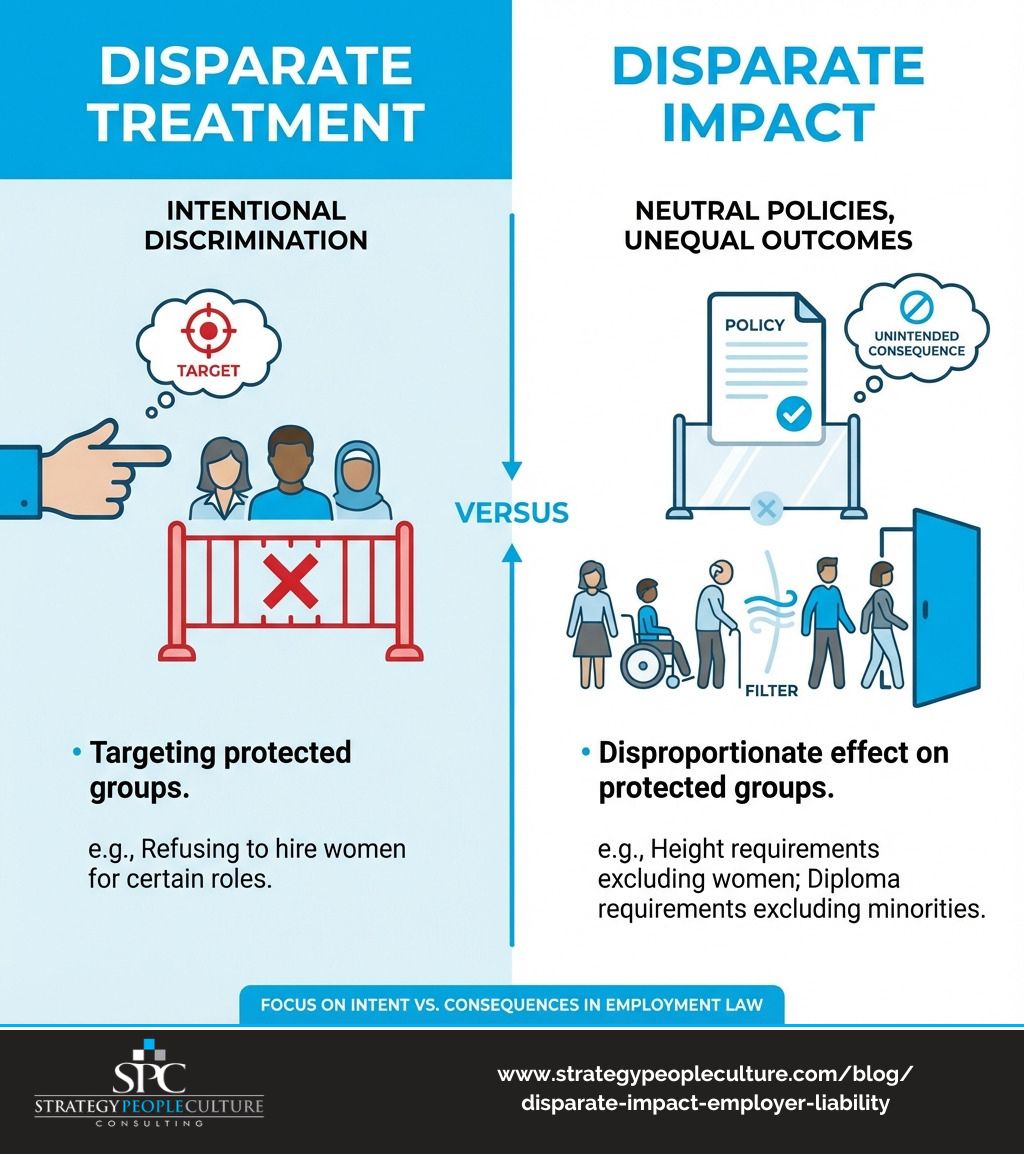
At its core, disparate impact refers to employment practices that, while appearing neutral and applied equally to everyone, disproportionately affect members of a protected class. These protected classes include individuals based on race, color, religion, sex (including pregnancy, gender identity, and sexual orientation), national origin, age (40 or older), disability, genetic information, and other protected classifications as defined by federal or state law.
The key distinction here is intent. Unlike “disparate treatment,” which involves intentional discrimination, disparate impact doesn’t require any malicious intent. A policy can be created with the best intentions, yet still lead to discriminatory outcomes. It focuses on the consequences of a policy, not the motivation behind it. This means that even if your hiring manager isn’t actively trying to exclude a certain group, if a hiring criterion disproportionately screens them out, it could be a disparate impact violation.
This concept is crucial for leaders because it challenges us to look beyond surface-level fairness. It asks us to examine whether our systems inadvertently create barriers to opportunity for some. This is often where systemic discrimination, rooted in historical biases or unexamined assumptions, can manifest. Understanding and addressing this requires a proactive leadership approach, often supported by Importance of Workplace Discrimination Training and Investigation.
The Landmark Case: Griggs v. Duke Power Co.
The concept of disparate impact isn’t new; it has deep roots in American legal history. Its foundation was laid by the U.S. Supreme Court in the landmark 1971 case, Griggs v. Duke Power Co.

This case arose when Black employees at Duke Power Company challenged the company’s requirement of a high school diploma or passing certain intelligence tests for employment or transfer into higher-paying departments. Historically, the company had openly discriminated against Black workers, confining them to the lowest-paying department. While the company eventually dropped overt discrimination, these new requirements, though neutral on their face, had a significant discriminatory effect. For example, in North Carolina, where Duke Power operated, 1960 census data showed that only 12% of Black males had completed high school, compared to 34% of White males. The tests also disproportionately screened out Black applicants.
The Supreme Court ruled that these requirements were unlawful because they were not shown to be related to job performance and had a disparate impact on Black employees. This ruling established that employment practices must be job-related and consistent with business necessity. The Court emphasized that Title VII of the Civil Rights Act of 1964 “proscribes not only overt discrimination but also practices that are fair in form, but discriminatory in operation.” This means that the “touchstone is business necessity”—if a practice has a disparate impact, the employer must prove it’s essential for the job. This ruling solidified the principle that the Supreme Court held that employment prerequisites unrelated to job requirements and resulting in hiring disparities violate Title VII.
Navigating the Shifting Landscape of Disparate Impact and Employer Liability
The legal and regulatory environment surrounding Disparate Impact and Employer Liability is constantly evolving. For leaders, this means maintaining a keen sense of awareness and adaptability. What might be considered acceptable today could become a liability tomorrow, or vice versa, depending on shifts in federal policy, judicial interpretation, and even state-level actions.
This dynamic landscape underscores the importance of strong Situational Awareness in the Workplace. It’s not enough to simply react; we must anticipate, understand, and proactively adjust our organizational strategies to minimize risk and foster a truly equitable environment.
How Neutral Policies Can Create Unintentional Bias and Risk
Even with the best intentions, seemingly neutral policies can inadvertently create unintentional bias and significant risk for your organization. As leaders, it’s our responsibility to identify these potential pitfalls. Consider the following examples that, while appearing fair, can lead to disparate impact:
- Hiring Criteria: Requirements like a high school diploma, while seemingly neutral, may disproportionately exclude certain demographic groups if they are not clearly linked to actual job knowledge, skills and abilities to perform effectively, as illustrated in Griggs v. Duke Power Co.
- AI Screening Tools: The use of artificial intelligence in hiring has grown rapidly, but algorithms can easily replicate or amplify existing biases in the data they are trained on. Without regular audits and human oversight, these tools can disproportionately screen out candidates based on race, ethnicity, sex, age, or disability.
- Physical Ability Tests: Some roles legitimately require physical capabilities, but generic or overly strenuous tests can create unnecessary barriers. When physical assessments are not validated as job-related and consistent with business necessity, they increase the risk of disparate impact on women, older workers, and people with disabilities.
- Background Checks: Policies involving criminal history or credit checks, even when intended to promote safety or trust, can disproportionately impact certain racial and ethnic groups. If these checks are broader than necessary, lack clear job-related criteria, or are applied inconsistently, they can create significant legal exposure.
- Promotion Practices: Vague, subjective, or informal promotion criteria (such as “culture fit” or manager discretion without documentation) can unintentionally favor employees who already resemble current leaders. This often results in underrepresentation of protected groups in higher-paying or leadership roles, raising both equity and liability concerns.
These examples highlight that the absence of overt prejudice does not guarantee the absence of discrimination. It’s about recognizing the subtle ways bias can creep into our systems and processes. This is where a deeper understanding of “Understanding Unconscious Bias with Andrew Botwin” becomes invaluable for leaders.
Federal Enforcement Changes and Ongoing Business Implications
The landscape of federal enforcement for disparate impact claims is undergoing a notable shift. In April 2025, President Trump issued an Executive Order 14281 entitled “Restoring Equality of Opportunity and Meritocracy.” This order “categorically rejected” the use of the disparate impact theory by federal agencies like the Equal Employment Opportunity Commission (EEOC).
Following this, the EEOC has instructed its staff to close almost all pending charges based solely on allegations of disparate impact discrimination. Indeed, the EEOC will close almost all pending charges based solely on allegations of disparate impact discrimination by September 30, 2025. This move marks a significant change from the EEOC’s historical role in investigating such claims.
So, what does this mean for your business? While federal agencies may be stepping back from initiating disparate impact investigations, this does not eliminate your organization’s liability. Here’s why:
- Private Litigation Continues: The executive order and EEOC directive do not prevent individuals from filing private lawsuits in federal court. If an employee believes a policy has a disparate impact, they can still pursue a claim. It is reasonable to anticipate private plaintiffs to continue and possibly accelerate their of filing these charges with the EEOC, often seeking “right-to-sue” letters to proceed directly to federal court.
- State Laws Remain Strong: Many states, including New Jersey, have their own anti-discrimination laws that recognize disparate impact liability. These state laws often provide robust protections that are independent of federal policy shifts. As a result, employees in states like New Jersey need to understand that federal posture such as the EEOC’s current position does not mitigate their liability at the state level and leaders in New Jersey and many other states must remain vigilant about state-level regulations.
- Department of Justice (DOJ) Focus: While the DOJ recently clarified that disparate impact liability is eliminated under Title VI for recipients of federal funding. It’s crucial to differentiate this from Title VII, which generally covers private employers and still recognizes disparate impact.
For leaders, this means that while the enforcement landscape is changing, the underlying risk of Disparate Impact and Employer Liability persists. Our approach to Leadership: Roe v. Wade Overturned and other critical issues must continue to be proactive and informed, recognizing that legal precedents and protections can shift.
Proactive Leadership Strategies to Mitigate Risk
In an environment where federal enforcement priorities are changing, but employer liability remains, proactive leadership is more critical than ever. We believe that preventing disparate impact isn’t just about avoiding lawsuits; it’s about building a stronger, more equitable, and ultimately more successful organization.

This involves a commitment to regular audits, thoughtful policy review, and ongoing leadership training. By integrating these elements, we can cultivate an intentional Workplace Culture that is both compliant and thriving.
How to Proactively Assess and Mitigate Disparate Impact and Employer Liability
As leaders, we have the power to shape our organizations to be resilient against Disparate Impact and Employer Liability risks. This isn’t a one-time fix but an ongoing commitment to fairness and data-driven decision-making. Here are concrete steps your leadership team can take:
- Conduct Regular Reviews of Employment Practices:
- Hiring Data: Analyze applicant flow, interview rates, and hiring rates across all protected groups. Are there statistically significant differences at any stage of the process? Are applicant criteria accurately reflective of who someone would perform in a role?
- Promotion & Pay Equity: Review promotion rates and compensation data by demographic. Ensure that processes for advancement and salary adjustments are fair and transparent.
- Termination & Performance Reviews: Examine patterns in performance ratings, disciplinary actions, and terminations. Are certain groups disproportionately affected?
- Review and Validate Selection Procedures:
- Job-Relatedness: For any employment practice that could have a disparate impact (e.g., tests, degree requirements, physical standards), ensure it is demonstrably job-related and consistent with business necessity. Can you articulate why this specific requirement is essential for successful job performance?
- Alternative Practices: If a practice shows disparate impact, explore less discriminatory alternatives that can achieve the same business objectives. For instance, instead of a general intelligence test, could a skills-based assessment directly measuring job tasks be used?
- Scrutinize AI and Automated Tools:
- If your organization relies on AI for recruiting, screening, or performance management, you need clarity on how these systems are designed and trained. Are they embedding or amplifying hidden biases? Build in regular, documented audits of AI decisions to catch and correct disparate impact early.
- Invest in Leadership Training Initiatives:
- Tone from the top matters. Educate your leadership team and employees on unconscious bias, fair employment practices, and the importance of an inclusive culture. Leaders who do not understand their own limitations and adapt based on their weaknesses can inadvertently create significant cultural and risk challenges.
- Consult with Experts:
- Navigating the complexities of disparate impact requires specialized knowledge. Partner with HR consultants and legal counsel to conduct objective analyses, review policies, and ensure compliance with both federal and local state laws.
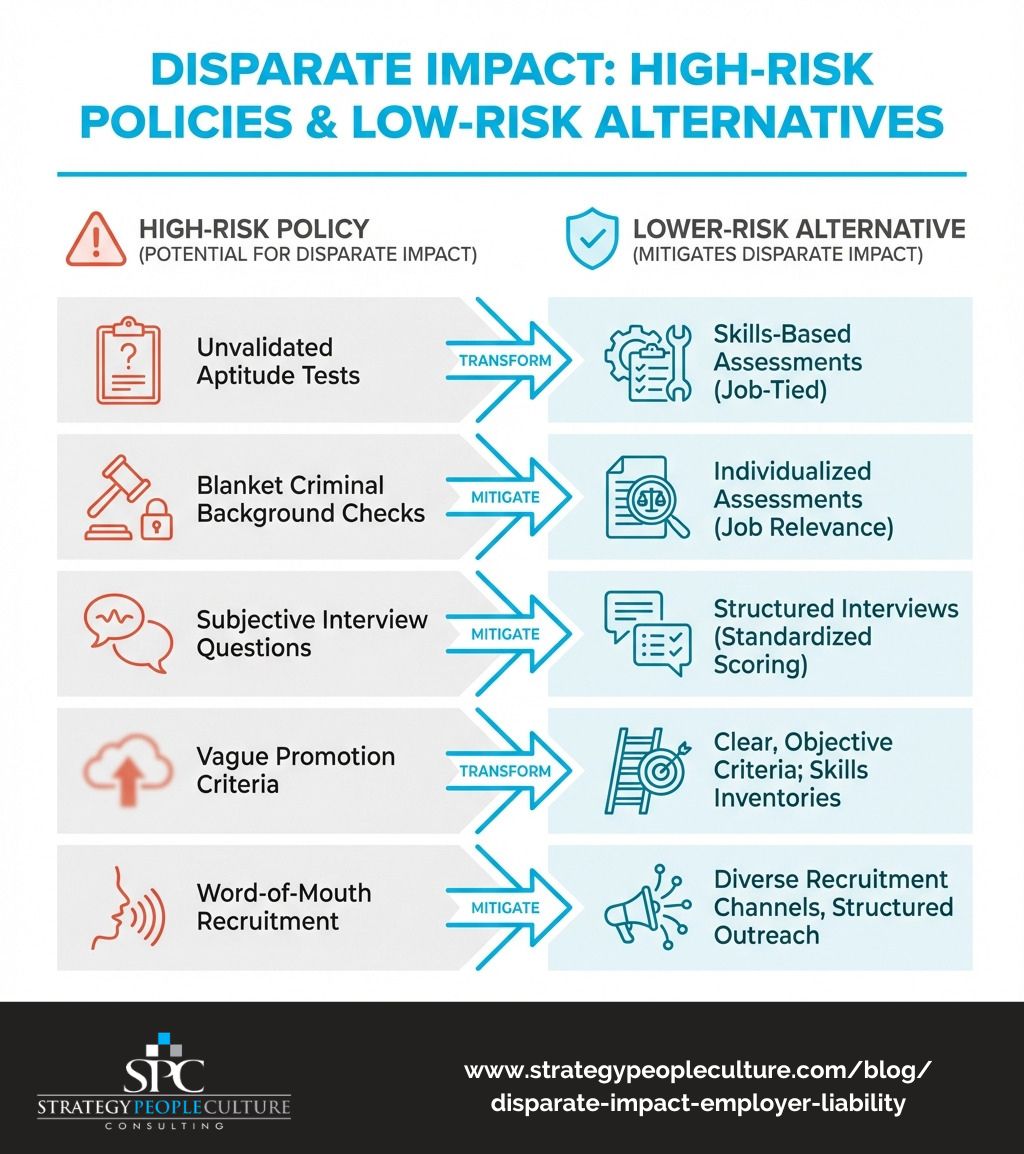
Here’s a table illustrating some high-risk policies and their lower-risk alternatives:
| High-Risk Policy (Potential for Disparate Impact) | Lower-Risk Alternative (Mitigates Disparate Impact) |
|---|---|
| Unvalidated aptitude tests | Skills-based assessments directly tied to job tasks |
| Blanket criminal background checks | Individualized assessments for job relevance |
| Subjective interview questions | Structured interviews with standardized scoring |
| Vague promotion criteria | Clear, objective criteria; skills inventories |
| “Word-of-mouth” recruitment | Diverse recruitment channels, structured outreach |
By proactively implementing these strategies, your organization can move beyond mere compliance to build a truly meritocratic and inclusive workplace. For expert guidance on ensuring your practices are fair and compliant, explore our Workplace Investigations services. We are here to help your leadership team steer these complexities and transform potential liabilities into opportunities for growth and cultural strength.