
2026 Workplace Investigation Updates: Legal and Legislative Changes Every Leader Must Know
What Changed in 2026: The Legal Landscape Leaders Are Investigating Within
The legal ground beneath workplace investigations shifted in 2026. On January 22, 2026, the EEOC voted to rescind its 2024 Enforcement Guidance on Harassment in the Workplace, removing the federal interpretive framework around which many employers built their investigation playbooks. State legislatures moved in the opposite direction. New Jersey expanded notice and posting obligations under the Conscientious Employee Protection Act, with civil fines up to $10,000 for a first violation and $20,000 for each subsequent one. New York enacted the Trapped at Work Act, banning “stay or pay” employment promissory notes and a near-total prohibition on consumer credit checks in hiring, effective April 18, 2026.
Investigation protocols built on the rescinded EEOC guidance, on outdated state notice requirements, or on the assumption that federal guidance sets the floor will not hold up in 2026. Retaliation remains the most-filed EEOC charge, and a Utah federal jury recently awarded $5 million in a single retaliation case against an employer that mishandled an HR employee’s discrimination complaint. The financial exposure tied to investigation missteps is real, and it is rising.
This article walks through the 2026 legal and legislative changes that affect how leaders should investigate today, with particular focus on multi-state employers and those operating in New Jersey, New York, and California. The procedural foundation of a sound investigation has not changed. The legal context surrounding it has — and that context is what determines whether your investigation is defensible or exposes the organization.
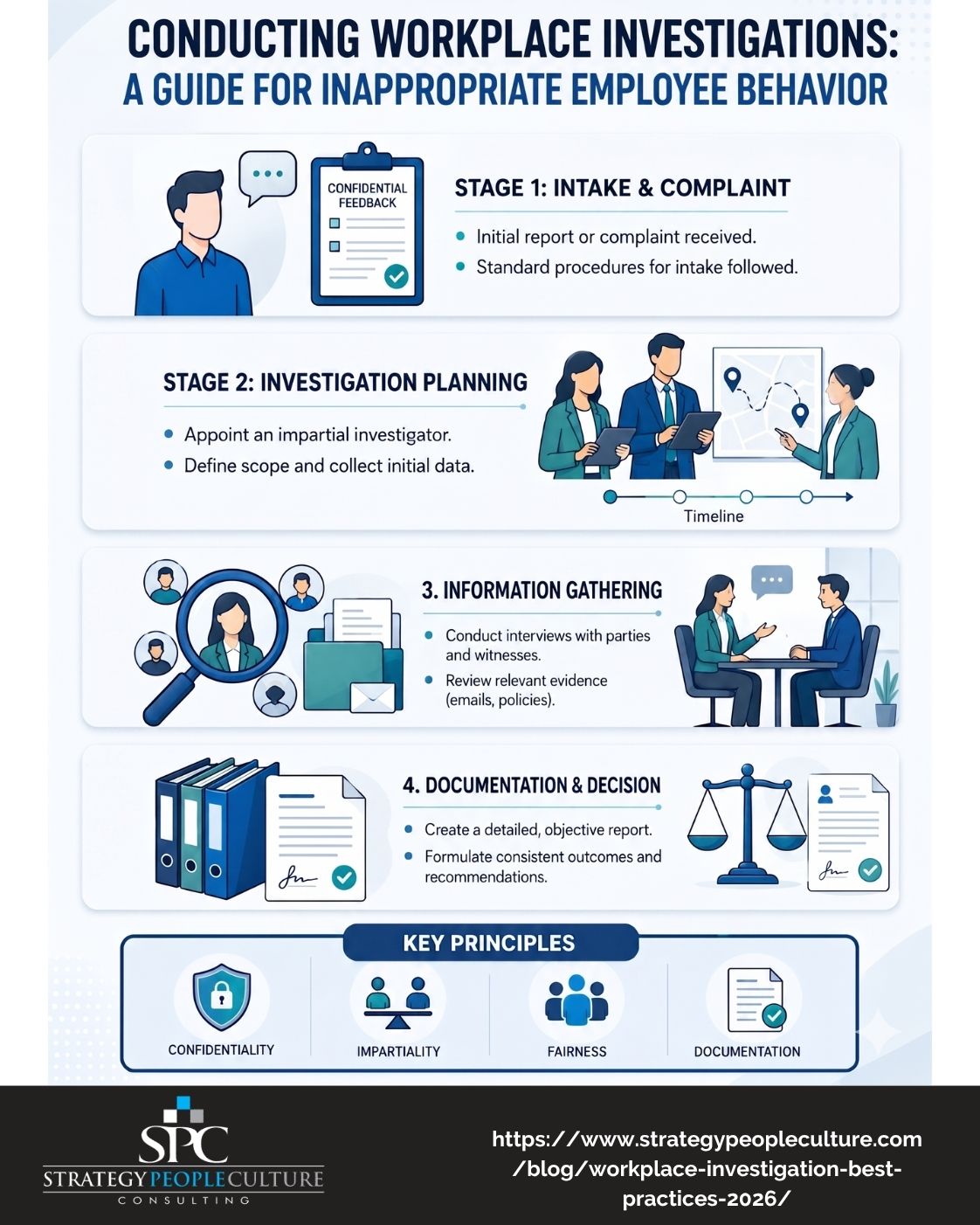
Follow these steps as the procedural foundation. The 2026 legal updates that follow show where the standards have tightened around them:
- Decide whether to investigate – Assess if a complaint requires a formal investigation.
- Choose an impartial investigator – Select someone with proper training and no conflicts of interest.
- Plan the investigation – Develop a clear scope, goals, and timelines.
- Gather evidence – Collect documents, interview witnesses, and preserve all relevant information.
- Maintain confidentiality – Protect privacy while ensuring fairness.
- Analyze findings – Evaluate evidence to determine what most likely happened.
- Report conclusions – Document findings, rationale, and have clarity on the investigator’s role when it comes to pure fact finding as opposed to offering recommendations.
- Take appropriate action – Implement corrective measures and communicate outcomes.
- Follow up – Monitor the resolution and ensure no one is treated unfairly for participating.
The 2026 legal updates that change how this checklist gets executed:
- EEOC rescission of 2024 harassment guidance (January 22, 2026): The Commission removed the entire 2024 guidance, not just sections related to gender identity or reproductive rights. Underlying federal law did not change — Title VII still applies, Bostock remains a valid precedent — but the interpretive roadmap is gone. Internal investigation protocols that cited the 2024 guidance need updated authority.
- NJ CEPA notice and distribution mandate: New Jersey employers with 10 or more employees must post and annually distribute the CEPA notice in English and Spanish, including the name and contact information of the person designated to receive whistleblower complaints. A mishandled whistleblower investigation now layers CEPA fines on top of the underlying claim.
- NJ algorithmic discrimination guidance under NJLAD: The NJ Attorney General clarified that the Law Against Discrimination applies to AI-driven employment decisions the same way it applies to human ones. Investigations involving hiring, promotion, or termination decisions made wholly or partly by AI tools now need to examine the tool’s bias, not just the human reviewer’s.
- NY Trapped at Work Act (effective December 19, 2025): Bans “employment promissory notes” — stay-or-pay clauses requiring repayment if a worker leaves before a stated period. Investigations involving training reimbursement, sign-on bonus clawbacks, or non-compete enforcement need to assess whether the underlying agreement is now unenforceable.
- NY consumer credit history ban (effective April 18, 2026): Use of credit reports in hiring or employment decisions becomes an unlawful discriminatory practice except for narrow exemptions. Investigations into background check practices need to verify whether each position falls within an exemption.
- NYC ESSTA expansion (effective February 22, 2026): Earned Safe and Sick Time can now be used to recover from workplace violence and to attend related legal proceedings. Investigations into workplace violence incidents now intersect with leave protections that did not previously apply.
- EEOC enforcement priorities under Chair Lucas: The Commission has signaled increased focus on religious accommodation claims and discrimination claims by employees in traditional majority groups. Neutrality across protected classes — long a best practice — is now an enforcement priority.
What this means operationally: an investigation that meets the procedural checklist above can still expose the organization if it ignores these state-level shifts or relies on a rescinded federal framework. Multi-state employers face the steepest curve, since California (SB 513, SB 642, SB 446, SB 294), Washington (workplace violence prevention investigation requirements), and Illinois (IDHR fact-finding conferences now voluntary) each pulled investigation standards in different directions in 2026.
I’m Andrew Botwin, founder of Strategy People Culture. With over three decades bridging HR strategy, executive coaching, and workplace investigations, plus a JD and active bar admissions in New Jersey and New York, I conduct independent neutral investigations across the multi-state legal landscape that just shifted under your feet. The procedural rigor matters. The legal context behind it matters more — and that context is what most internal investigations miss.
What’s New for 2026: Five Legal Changes That Affect How You Investigate
Five 2026 developments have changed how leaders should approach investigations. None is abstract. They affect what evidence you preserve, who you can interview without notice, what you can say in a separation agreement, and how a regulator will read your file if a charge is filed.
1. EEOC Has Pivoted to Aggressive Enforcement With New Theories
The Commission secured $660 million in FY2025, with systemic investigation recoveries up 115%. Under Chair Andrea Lucas, the agency is pursuing reverse-discrimination theories, scrutinizing DEI-related practices, and using Commissioner-initiated charges that don’t require an employee complaint. Disparate-impact theory has been deprioritized at the federal level — field offices were directed to close pending charges based solely on disparate impact as of October 31, 2025 — but states still enforce it, so the analysis you skip federally still matters locally.
2. State Confidentiality and Settlement Rules Have Tightened
Illinois amended its Workplace Transparency Act effective January 1, 2026, restricting confidentiality clauses in settlement and separation agreements, prohibiting venue and choice-of-law clauses that move disputes outside Illinois, and requiring separately bargained-for consideration when confidentiality is a term. New Jersey continues to bar nondisclosure provisions covering harassment, discrimination, and retaliation claims under N.J.S.A. 10:5-12.8. The investigator’s handling of confidentiality during the process — and the agreement language used at resolution — both have to be reviewed against current law before, not after, you sign anything.
3. Retaliation Claims Are the EEOC’s Most Common — and Rising
Retaliation has remained the most-filed EEOC charge category for over a decade, and law firms tracking 2026 trends flag it as a continuing growth area. New York applies a broader retaliation standard than federal law: any action that might reasonably discourage someone from making or supporting a complaint can qualify, including schedule changes, exclusion from meetings, or sudden documentation of minor issues that weren’t problems before. The investigator’s job no longer ends when the report is signed — what happens to the complainant in the 90 days after is part of the legal record.
4. AI in Employment Decisions Now Sits Inside the Investigation Scope
Illinois’ Human Rights Act amendments, effective January 1, 2026, require employers to notify applicants and employees when AI is used in hiring, promotion, discipline, or discharge decisions, and prohibit AI use that produces discrimination. Colorado’s AI law has parallel requirements. If a complaint touches a decision an algorithm contributed to — a flagged performance score, a termination recommendation, a routing of a complaint — the investigator now has to examine the AI’s role, not just the human decision. The EEOC has made clear that vendor “bias-free” claims are not a defense.
5. The “Severe or Pervasive” Standard Has Eroded in Multiple States
New York abandoned the federal severe-or-pervasive harassment threshold and now applies an inferior terms, conditions, or privileges standard. California, New Jersey, and several others have moved in similar directions. Conduct an investigator might have closed as below the legal bar five years ago can sustain a claim today. The credibility analysis and the conclusion section of an investigation report are doing more legal work than they used to.
The Investigation Process Under 2026 Legal Standards
The procedural fundamentals haven’t changed. The legal weight on each one has. Each phase below covers what stays the same and what’s new for 2026.
Phase 1: Preparation and Planning
Preparation is where most exposure is created or avoided. Decisions made before the first interview shape every legal argument that follows.
Determine the Need for Investigation: Formal complaints, anonymous reports, and management observations all create a duty to act. The threshold has dropped — under New York’s current standard, conduct that previously didn’t appear to clear the harassment bar may still create liability if you don’t investigate. When in doubt, investigate.
Select an Impartial Investigator: The investigator must be competent, neutral, and have no personal stake in the outcome.
- Internal: HR professionals are cost-effective when they have the specific training to handle the case at hand. A complaint involving a senior leader, a protected characteristic, or potential reverse-discrimination claims often outpaces internal capability.
- External: Recommended for complex matters, complaints involving senior leadership, or any case likely to attract regulatory attention. With EEOC Commissioner-initiated charges and systemic investigations both rising, third-party neutrality is increasingly worth the cost.
Establish Timelines and Interim Measures: New York’s 30-day investigation expectation is not aspirational. Delays get cited in retaliation claims, in agency findings, and at trial. Document the timeline you committed to, the dates you hit, and the reasons for any extension. Interim measures like separating parties or paid administrative leave still belong in the toolkit, but the legal advice on each one differs by state — a “protective” transfer that disadvantages the complainant has been read as retaliation in multiple recent cases.
Phase 2: Fact-Finding and Information Gathering
This phase focuses on the objective collection of information rather than “fault-finding”.
Fact-Finding and Evidence Gathering: Investigations must be focused on fact-finding—objectively gathering information—not fault-finding. Systematically collect all relevant evidence, including:
- Documents: Personnel files, company policies, emails, text messages, Slack/Teams threads, and incident reports. If any algorithmic tool is fed into a relevant employment decision (performance scoring, scheduling, termination recommendation), preserve the inputs, outputs, and audit logs. Illinois, Colorado, and other states now treat that data as discoverable in employment claims.
- Physical Evidence: Security footage, access logs, or damaged property.
The Interview Process: Interviews are the cornerstone of the investigation. Effective investigators use the following techniques:
- Establish rapport: The goal of witness interviews is to obtain any and all relevant information the witness may have to help understand the circumstances around the allegations. Establishing a working conversation with the witness can be extraordinarily helpful.
- Use open-ended questions: Instead of “Did he yell at you?”, ask “Can you describe the interaction?”
- Practice active listening: Pay close attention and ask clarifying questions. Strong Listening Improve Leadership Skills are crucial for investigators.
- Maintain a neutral tone: Objectivity is essential to avoid the appearance of bias.
- Take detailed notes: Document all interviews thoroughly.
Preserving Evidence and Maintaining Privacy: Investigation records should be stored securely and separately from personnel files. California’s SB 513, effective in 2026, redefines training and education records as personnel records subject to inspection — a reminder that what counts as “investigation” material versus “personnel” material can shift under state law. Confidentiality also has limits: the EEOC and NLRB have both warned against blanket gag instructions that prevent witnesses from discussing the investigation, particularly in cases that could implicate Section 7 rights.
Phase 3: Analysis, Reporting, and Drawing Conclusions
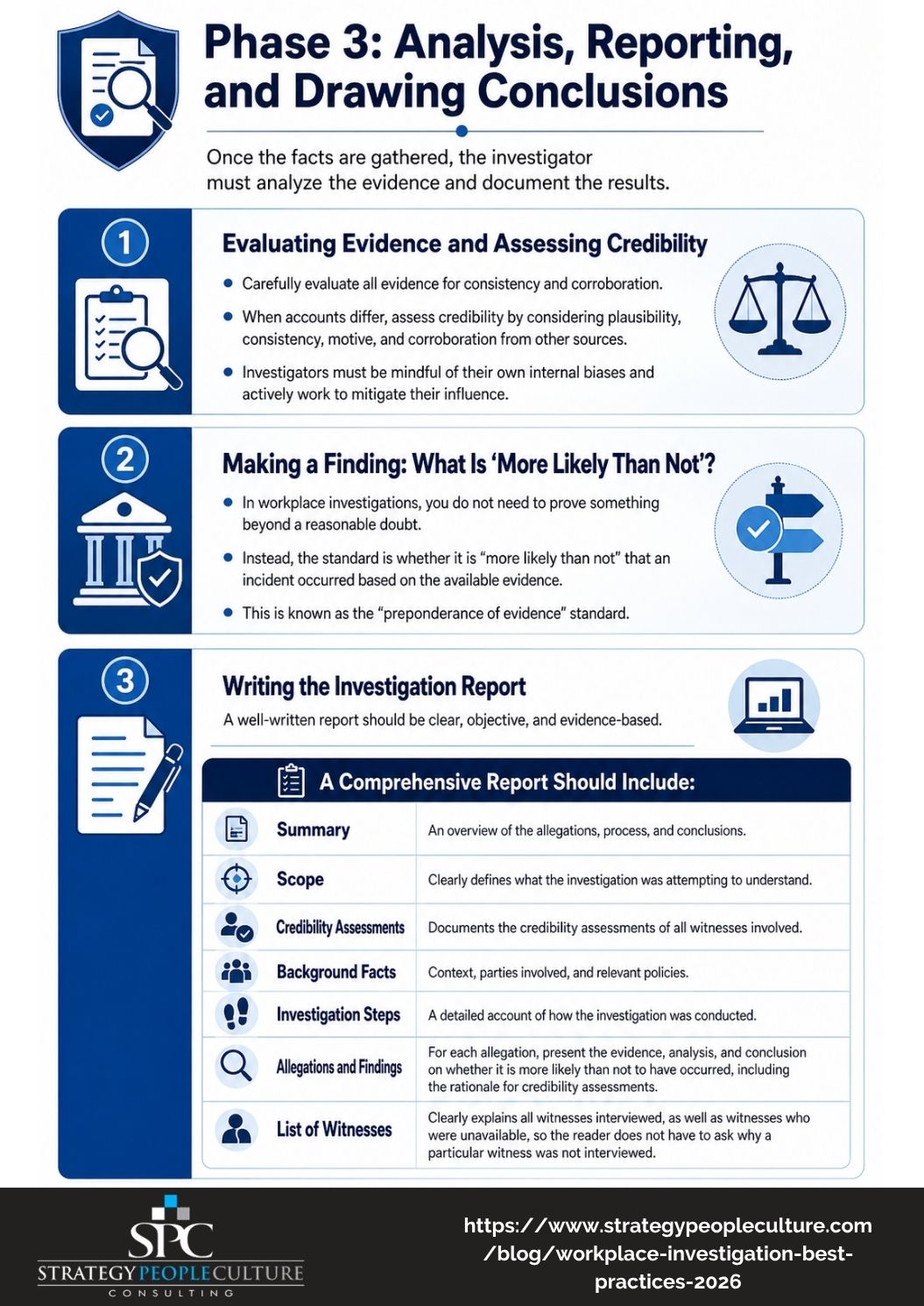
Once the facts are gathered, the investigator must analyze the evidence and document the results.
Evaluating Evidence and Assessing Credibility Carefully evaluate all evidence for consistency and corroboration. When accounts differ, assess credibility by considering factors like plausibility, consistency, motive, and corroboration from other sources. Investigators must be mindful of their own internal biases and actively work to mitigate their influence.
Making a Finding — What “More Likely Than Not” Means: Workplace investigations apply the preponderance-of-the-evidence standard — more likely than not — rather than the criminal beyond-a-reasonable-doubt standard. State the standard explicitly in the report. Plaintiff’s counsel and regulators will assume you applied the right one if you say so; ambiguity invites a reread of the entire file under whichever standard helps their argument.
Writing the Investigation Report A well-written report is the culmination of the process. It must be clear, objective, and evidence-based, as emphasized in a Clear Internal Investigation Process. A comprehensive report should include:
- Summary: An overview of the allegations, process, and conclusions.
- Scope: Clearly defining what the investigation was attempting to understand.
- Credibility Assessments: An often overlooked element to a strong investigation report is making and documenting credibility assessments of all witnesses involved.
- Background Facts: Context, parties involved, and relevant policies.
- Investigation Steps: A detailed account of how the investigation was conducted.
- Allegations and Findings: For each allegation, a presentation of the evidence, analysis, and a conclusion on whether the allegation is more likely than not to have occurred, including the rationale for credibility assessments.
- List of Witnesses: Clearly explaining all witnesses interviewed, as well as witnesses who were unavailable. The investigation should help the ultimate reader of the report avoid having to ask the question, “Why didn’t the investigation interview a particular witness?
After the Investigation: Where Most Retaliation Claims Are Born
The investigation doesn’t end with the report — and neither does the legal exposure. Retaliation has been the most-filed EEOC charge category for over a decade, and the conduct that generates it almost always happens after the investigation concludes.

Implementing Outcomes and Communicating with Stakeholders
Based on the findings, appropriate corrective actions must be taken. These can range from coaching and training to disciplinary measures for substantiated misconduct. Actions should be consistent with past practices and appropriate for the severity of the issue. Important to remember, the investigator’s role in fact-finding and organizational leadership has the responsibility to determine how to action the results of the investigation.
The outcome should be communicated to the complainant and respondent, informing them of the conclusion while respecting privacy. It’s also crucial for an organization to implement corrective action steps to help avoid recurrence of issues that may have been uncovered as a result of the incident and validated through the investigation. This might involve Why Harassment Discrimination Training or policy updates to prevent a Hostile Work Environment.
A fair process followed by clear action helps rebuild trust. Why is Trust Important in Leadership cannot be overstated. Protection of complainants, witnesses, and respondents from negative consequences is a leader’s core responsibility — and a legal one. New York’s retaliation standard captures any action that might reasonably discourage someone from making or supporting a complaint, including subtle ones: schedule changes, exclusion from meetings, sudden written warnings for issues that weren’t problems before. Track and audit those signals in the 90 days after the investigation closes. That window is where most retaliation claims are made.
The Quantifiable Cost of Failure
Failing to conduct proper investigations carries quantifiable costs:
- Direct Financial Exposure: The EEOC recovered $660 million from employers in FY2025 alone, with average per-charge recoveries climbing year over year. State-level recoveries under NJLAD, the New York Human Rights Law, and similar statutes can run higher than federal limits, since most state laws don’t cap compensatory or punitive damages.
- Erosion of Trust: A poorly handled investigation can destroy leadership credibility and employee confidence in management.
- Damaged Reputation: Loss of employee faith and a tarnished public image, often amplified through Glassdoor and social media before any formal claim is filed.
- Decreased Productivity: Disengagement and low morale in environments where employees believe complaints aren’t taken seriously.
- Increased Turnover: The True Cost of Employee Turnover rises sharply when employees don’t feel safe.
Key Takeaways for 2026
A defensible investigation in 2026 looks different from what it did even two years ago. The procedural fundamentals haven’t changed, but the legal weight on each one has.
- Match Your Process to the Current Legal Standard: Lower harassment thresholds in New York, the broader retaliation standard, and tightened state confidentiality rules all change the calculus on whether to investigate, who should investigate, and what the report needs to say.
- Document the AI Layer: If an algorithmic tool contributed to any decision involved in a complaint, treat its inputs, outputs, and audit trail as discoverable evidence. State AI laws (Illinois, Colorado, others) now require notice and create new claims.
- Track Post-Investigation Conduct: Most retaliation claims are based on what happened in the 30 to 90 days after the investigation closed. Build that monitoring into the process.
- Get External Neutrality on the Right Cases: Senior-leader complaints, reverse-discrimination claims, cases likely to draw regulatory attention, and any matter where the internal investigator has even an apparent conflict warrant a third-party investigator.
- Update Settlement and Confidentiality Templates Before You Need Them: Illinois, New Jersey, California, and others have all narrowed what employers can include in resolution agreements. Old templates create new claims.
At Strategy People Culture, we conduct neutral third-party workplace investigations, train internal investigators, and advise leadership through complaints across the United States and Canada. If you’re reviewing your investigation process against the 2026 legal landscape, we can help find the gaps before a regulator or plaintiff’s counsel does. Schedule a confidential conversation.