The Ultimate Guide to Leadership & Management Development
Why Leadership and Management Development is Critical for Organizational Success
Leadership and management development is the process of building the skills of individuals to lead teams and manage resources effectively. While distinct, both are critical for success.
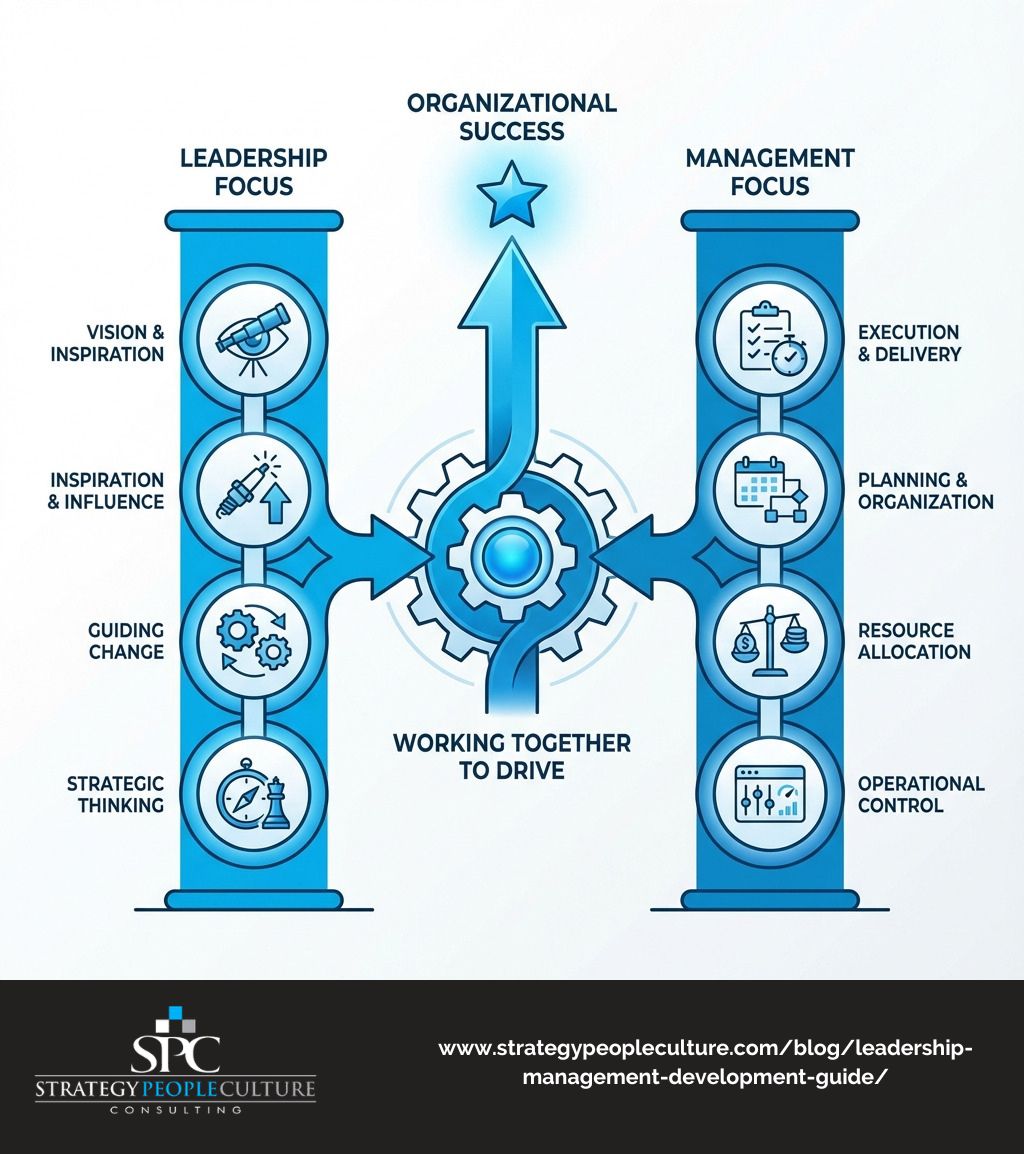
- Leadership Development focuses on vision, inspiration, and guiding change. It answers the “why” people would want to follow, go the extra mile and do their best for the person leading them.
- Management Development emphasizes planning, execution, and operational excellence. It handles the “how” a team and individual should be meeting expectations of the manager.
- Core Purpose: To improve organizational performance, employee engagement, and create ongoing competitive advantages.
- Key Outcome: Strong development programs lead to better talent retention and can result in 70% higher team engagement.
- Strategic Imperative: In today’s knowledge economy, an organization’s growth is limited by the capability of its leadership.
A proactive approach to developing both leaders and managers is essential in the modern business environment. It creates a skilled cadre capable of driving results while building a culture where people want to stay.
I’m Andrew Botwin, founder of Strategy People Culture, LLC. We help businesses transform their workplace cultures through strategic leadership and management development. Our work combines executive coaching and expertise around organizational culture to build the leadership capabilities needed for sustainable growth.
The Strategic Framework for Leadership and Management Development
In today’s knowledge economy, a business may be limited to the capability of its leadership. Investing in robust leadership and management development is a strategic imperative, not an expense. The current environment, marked by rapid technological change and globalization, demands leaders who can drive performance and engagement. A proactive, systematic approach to development is the hallmark of successful organizations, allowing them to cultivate a talent pipeline and ensure they have the right people to meet future challenges.

Leadership vs. Management: Understanding the Core Differences
While often used interchangeably, leadership and management are distinctly interdependent. Management is about efficiently climbing the ladder of success; leadership determines if the ladder is against the right wall.
Management focuses on the “how”—the processes that keep an organization running smoothly. A manager’s role involves planning, budgeting, staffing, monitoring performance, and problem-solving to maintain stability.
Leadership is about the “why”—inspiring people towards your vision and driving change. A leader’s role involves creating a vision, motivating people, influencing teams, and fostering innovation. Leadership isn’t tied to a formal title and can be practiced at any level.
Here’s a quick comparison:
| Feature | Leadership | Management |
|---|---|---|
| Primary Focus | Vision, Inspiration, “Why” | Execution, Planning, “How” |
| Goal | Drive change, innovate, set direction | Maintain stability, optimize operations |
| Key Activity | Influencing, motivating, developing people | Organizing, controlling, problem-solving |
| Time Horizon | Long-term, strategic | Short-term, tactical |
| Authority | Earned through influence and trust | Derived from position and responsibility |
| Risk Tolerance | Accepts risk and uncertainty | Minimizes risk, ensures predictability |
Optimal performance requires both. A brilliant vision without effective execution is just a dream, while efficient operations without a compelling direction lead to stagnation. Effective leadership and management development fosters individuals who can both inspire and implement. For more on this, see our insights on Good Leadership.
Key Competencies and the Business Case for Development
Developing a robust set of competencies for both leaders and managers is paramount for sustainable growth.
Key Leadership Skills:
- Vision and Strategic Thinking: Anticipating future trends and aligning the organization with long-term goals.
- Emotional Intelligence (EQ): Building trust and inspiring collaboration. The demand for emotional intelligence will increase by 26% by 2030, and nearly half of employees see it as a key leadership trait. Learn more about Emotional Intelligence in Leadership.
- Adaptability: Pivoting quickly in response to new challenges. 71% of executives report agility and adaptability is the top skill they seek in leaders.
- Communication and Influence: Inspiring action and aligning teams around a shared vision.
- Decision-Making and Accountability: Making informed choices and taking ownership of the outcomes.
Key Management Skills:
- Planning and Organization: Setting clear objectives and structuring tasks.
- Delegation: Empowering team members and ensuring accountability.
- Problem-Solving: Resolving operational challenges effectively.
- Resource Management: Efficiently using financial and material resources.
- People Management: Clarifying roles, giving feedback, and managing team dynamics.
Investing in development offers profound advantages. For individuals, it leads to career growth, increased confidence, and greater job satisfaction. For organizations, benefits include higher retention, improved performance, and improved innovation. Strong leadership is critical for strategy execution, as studies show 67% to 90% of strategies fail without it.
Designing Effective Leadership and Management Development Programs
Effective programs must align with business priorities, identifying a key goal—such as increasing revenue or cutting costs—that the development will support.
Content must be custom to different leadership levels:
- Frontline Leaders: Need tactical skills in communication, team-building, and decision-making.
- Mid-Level Leaders: Require development in strategic thinking and cross-departmental influence.
- Executive Leaders: Focus on organizational vision, global strategy, and leading change.
A blended learning approach using coaching, workshops, e-learning, and stretch assignments is most effective. Our Leadership Coaching to Unlock Potential offers personalized guidance.
The Role of Culture and Senior Leadership in Driving Success
Even the best programs fail without a supportive organizational culture. Key cultural elements for success include psychological safety, a commitment to continuous learning, and a foundation of trust.
Senior leadership involvement is also crucial. Their visible commitment signals the importance of development through:
- Leaders as Teachers: Sharing experiences to make learning relevant.
- Sponsorship and Mentorship: Providing invaluable guidance to emerging leaders.
- Role Modeling: Demonstrating a commitment to their own continuous learning.
We help organizations build an Intentional Culture and Leadership where development flourishes.
Measuring Impact and Overcoming Modern Challenges
To prove value, measure impact by aligning metrics to business outcomes, calculating ROI and ROE (Return on Expectation), and using assessments to track behavioral change.
Common challenges include resistance to change and lack of time. Overcome these by:
- Securing strong buy-in from all stakeholders.
- Integrating learning into the daily workflow.
- Fostering a psychologically safe environment.
- Providing continuous support through coaching and feedback to promote Leadership Accountability in Business.
Cultivating Balance and Continuous Improvement
Optimal performance requires a balance between leadership (vision) and management (execution). Development is an ongoing journey rooted in a growth mindset—the belief that leaders are made, not born. Key components include self-reflection, seeking feedback, and practicing adaptability in the face of change. Together, these habits build resilient leaders who grow through challenges instead of being defined by them.
Conclusion: Opening Up Your Organization’s Potential

In conclusion, leadership and management development are two sides of the same coin, both indispensable for organizational success. Leadership provides the vision, while management ensures the execution. Neglecting one cripples an organization’s potential.
Investing in both is a strategic imperative that boosts engagement, retention, and innovation. Success hinges on custom program design, a supportive culture, and active senior leadership. This development is a continuous journey of learning and adaptation.
At Strategy People Culture, LLC, we understand that developing effective leaders is not a one-size-fits-all endeavor. With Andrew Botwin’s 30+ years of experience, we integrate coaching and training to foster success for businesses throughout United States, Canada and beyond. Our professional, insightful, and custom approach ensures your organization has the capable leaders it needs to thrive.
Ready to open up your organization’s potential? Find out how our comprehensive services can help you cultivate leaders who meet today’s challenges and shape tomorrow’s opportunities. Learn More info about Executive Leadership Coaching services.