
Everything You Need to Know About Workplace Investigations
Why Workplace Investigations are a Critical Leadership Function
Workplace investigations are an essential leadership tool for addressing allegations of misconduct, harassment, or discrimination. When conducted properly, they uncover the facts, show employees their concerns are taken seriously, and protect the organization from legal liability.
Key Elements of Workplace Investigations:
- Purpose: Gather facts to determine if misconduct occurred and guide appropriate corrective action.
- Legal Obligation: Required under federal and provincial laws when harassment, discrimination, or violence allegations arise.
- Timeline: Must be completed promptly and the interpretation of timely will vary from jurisdiction to jurisdiction. For example, under the Canada Labour Code, investigations often must be acknowledged very quickly and the investigaiton must start within 45 days and be completed wihtin a year.
- Outcome: Results in findings, recommendations, and documented actions that protect all parties.
- Record-Keeping: Investigation records as a best practice should be retained for 10 years under certain federal regulations.
As a leader, you face significant risks if investigations are handled improperly. A flawed process can expose your organization to lawsuits, damage morale, and harm your reputation. Conversely, a well-executed investigation builds trust, resolves conflict, and fosters a healthier workplace culture.
The challenge is that most leaders lack formal training in investigation methodology. You’re expected to steer complex legal requirements, maintain impartiality, and produce defensible reports—all while managing the daily pressures of your role.
I’m Andrew Botwin, founder of Strategy People Culture, LLC. With experience in workplace investigations across multiple industries, I combine legal expertise with HR strategy to help leaders steer these sensitive situations. I’ve seen how proper investigations resolve immediate issues and strengthen organizational culture for the long term.
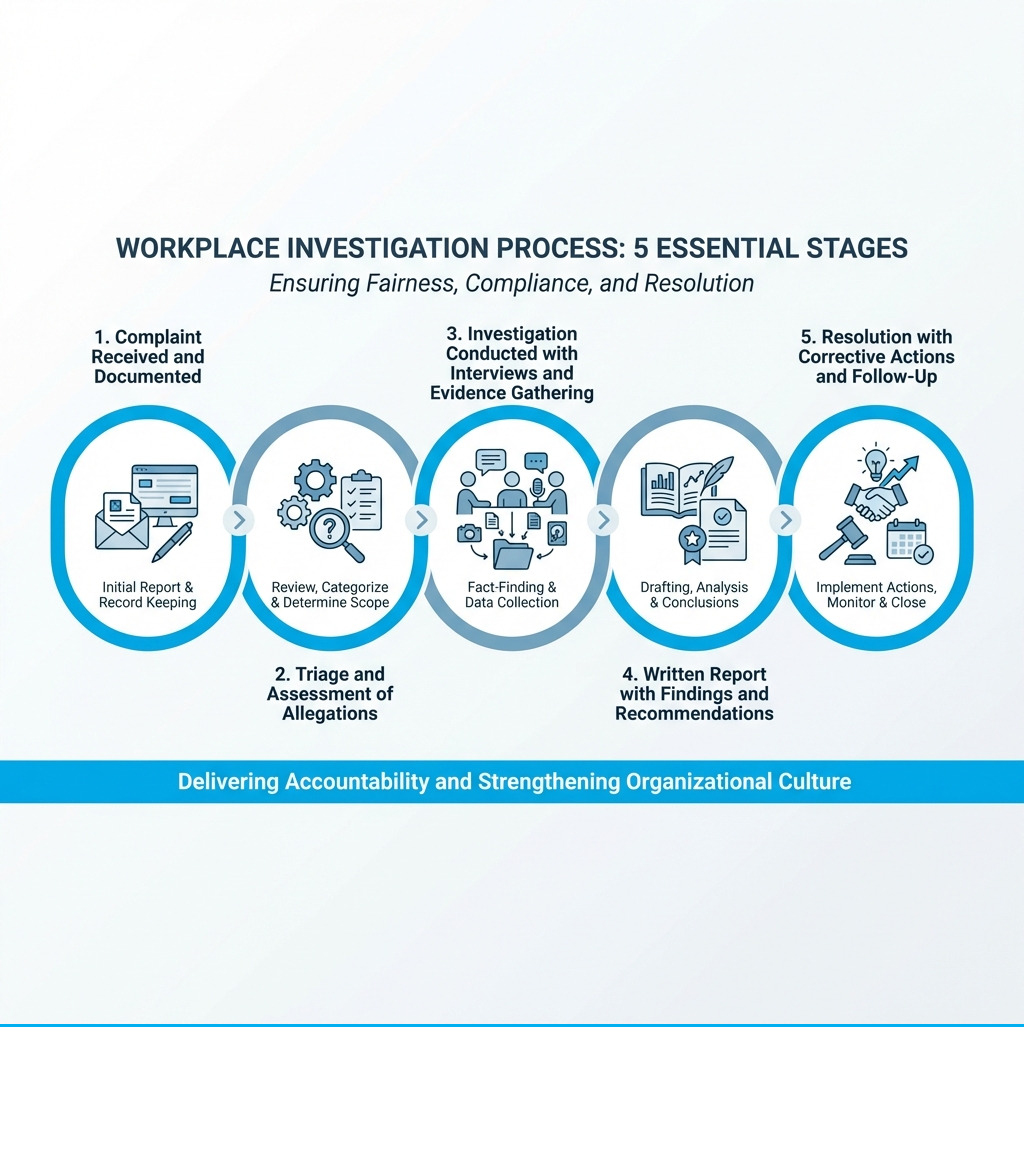
The Essential Framework for Workplace Investigations
Understanding the Legal Landscape and Employer Obligations
Workplace investigations are a legal imperative, not just good practice. As a leader, understanding this framework is key to ensuring compliance and fostering a respectful environment. While our firm is based in New Jersey, we look to robust regulatory frameworks, like those in Canada, as benchmarks for best practices.
Generally, workplace harassment is defined as unwelcome conduct that demeans or humiliates, while workplace violence includes actions or threats that could cause harm. The key takeaway for leaders is that the impact on the employee often outweighs the intent of the alleged harasser.
Across jurisdictions, including New Jersey’s Law Against Discrimination (LAD), employers have clear obligations:
- Prevent: Proactively implement policies, training, and risk assessments.
- Investigate: Respond promptly and effectively to all allegations.
- Ensure Fairness: Guarantee an impartial process for all parties involved.
- Act: Implement recommendations and take appropriate corrective action.
- Document: Maintain detailed records. For example, under the Canada Labour Code, an investigation must be concluded within one year and records kept for ten years.
Our role is to impartially provide fact finding with expertise and care.
Initiating the Investigation: When are formal workplace investigations necessary?
Deciding when to initiate a formal workplace investigation is a critical leadership decision.
What are the different types of complaints that typically trigger a workplace investigation?
Investigations can be triggered by various serious allegations:
- Harassment (sexual, racial, psychological) and discrimination
- Workplace violence or threats
- Bullying and mobbing
- Breaches of company policies (e.g., code of conduct, ethics)
- Employee misconduct (e.g., theft, fraud)
- Abuse of authority
- Whistleblower reports
How should an employer assess allegations to determine if a formal investigation is warranted?
Leaders should conduct an initial “triage” to assess the severity, risk, and specificity of the allegation. Determine if it describes a potential violation of law or serious policy, such as harassment, violence, or discrimination. Serious allegations almost always require a formal investigation to meet legal obligations (e.g., under the NJ LAD). When in doubt, it is best to investigate. A clear internal investigation process is vital for consistency.
Informal resolution like mediation can work for minor conflicts if all parties agree and no significant power imbalance exists. However, a formal investigation is non-negotiable for serious allegations like violence or discrimination, situations with significant power imbalances, or where required by law.
While an investigation is ongoing, interim measures may be necessary to protect the parties and the integrity of the process. These temporary, non-punitive actions can include paid administrative leave, work reassignments, or no-contact orders. Our executive coaching helps leaders implement these measures strategically.
What are the essential qualifications of an effective workplace investigator?
Choosing the right investigator is paramount. Key qualifications include impartiality, legal knowledge, analytical skills, and discretion. An effective investigator must also have formal training in investigation techniques and a trauma-informed approach to interviewing, ensuring sensitivity without sacrificing objectivity. Our blog on Understanding Workplace Trauma explores this further.
Internal vs. External Investigations
- Internal investigators are cost-effective and know the company culture but may face perceptions of bias. They are best for less severe allegations where impartiality is clear.
- External investigators offer maximum impartiality and specialized expertise, which is crucial for serious allegations involving senior leadership or legal complexity. At Strategy People Culture, we often serve as external investigators to bring objectivity to sensitive matters.
Conducting Fair and Effective Workplace Investigations
A well-conducted investigation is the bedrock of trust. We execute this phase with precision and fairness.
Procedural fairness is the foundation of a defensible investigation. Key principles include ensuring the investigator is impartial, giving all parties the right to be heard and respond to evidence, providing the respondent with clear notice of the allegations, and making timely, evidence-based decisions based on the “preponderance of evidence” sometimes called the “balance of probabilities.”
Clear Terms of Reference (ToR) or a well articulated “scope” act as the investigation’s blueprint. This document should define the specific allegations and scope, identify the investigator, outline the process and timeline, and clarify the standard of proof (“balance of probabilities”).
Confidentiality is crucial for protecting privacy and encouraging reporting, but it is not absolute. Information is shared only on a need-to-know basis for the investigation, to implement corrective action, or to meet legal and safety requirements. Leaders should be aware that NDAs designed to silence victims are highly discouraged and may be legally unenforceable.
Effective interviews require skill and a trauma-informed approach. Best practices include:
- Prepare: Review documents and plan open-ended questions.
- Set the Stage: Explain the process, confidentiality limits, and rights in a private setting.
- Be Trauma-Informed: Prioritize psychological safety, listen patiently, and offer support resources. Our article on Understanding Workplace Trauma provides deeper insights.
- Document: Take detailed, accurate notes.
Interviews are typically conducted with the complainant first, followed by witnesses, and then the respondent.

Navigating Complex Allegations and Systemic Issues
Some workplace investigations dig into particularly sensitive or deeply rooted issues, demanding specialized expertise.
Investigating allegations of sexual harassment or violence is uniquely demanding. A trauma-informed approach is helpful, as trauma can affect memory. These cases often hinge on credibility assessments that go beyond “he said, she said” to include consistency, plausibility, and corroborating evidence. Leaders must also manage power dynamics, maintain heightened confidentiality, and actively prevent retaliation, a risk highlighted in our article on Workplace Retaliation Examples. The focus must always be on the impact of the conduct, not the intent. Understanding the nuances of sexual harassment in the workplace is crucial.
An investigation may uncover systemic issues like racism, bias, or mobbing (group bullying). This may require looking beyond a single incident to examine patterns in policies and culture. Investigators must be trained to mitigate their own unconscious biases to ensure objectivity. When systemic problems are suspected, the scope may widen to a full workplace assessment to address root causes, as a hostile work environment is often a symptom of deeper issues. Our expertise in workplace culture assessments helps pinpoint these underlying problems.
Concluding the Investigation: Reporting and Follow-Up
The investigation process culminates in a comprehensive report and a commitment to action.
A comprehensive investigation report should be clear, objective, and legally sound. Key components include an executive summary, a restatement of the allegations, an outline of the investigation process, an objective analysis of the evidence, and clear findings of fact for each allegation based on the balance of probabilities. The report concludes with whether allegations were substantiated and provides actionable recommendations for the employer.
After the investigation, leadership’s responsibilities are paramount. You must review the report, decide on and implement prompt, proportionate corrective actions, and communicate the outcome to the complainant and respondent. It is critical to monitor the workplace to prevent retaliation and consider workplace restoration efforts like mediation. Finally, securely maintain all investigation records for the legally required period (e.g., ten years under some federal regulations), keeping them separate from personnel files.
Fostering a Proactive and Compliant Workplace Culture
At Strategy People Culture, we believe in building organizations that thrive not just by reacting to issues, but by proactively cultivating a respectful and compliant culture.
Beyond the Investigation: Training and Prevention
To ensure legal compliance and promote a healthy culture, leaders must commit to a proactive approach. This includes developing robust policies, providing regular training, and championing a culture of respect. Our blog on Why Harassment Discrimination Training underscores its effectiveness. It’s also vital to establish clear reporting channels, ensure fair and consistent investigations, and offer confidential support systems like an EAP.
Continuous learning is vital for anyone conducting investigations. HR professionals and leaders can improve their skills through specialized certification programs, industry webinars, and legal update seminars. Customized in-house training from experts like Strategy People Culture can also be custom to your organization’s specific policies and needs.
At Strategy People Culture, we empower leaders and HR professionals. Our leadership training and executive coaching services provide the strategic insights and practical skills to steer complex investigations and cultivate a workplace culture where such issues are less likely to arise. We integrate coaching, investigations, and training to foster awareness and success for both people and business.

For expert guidance in conducting effective and compliant investigations that build trust and strengthen your organization, explore our Workplace Investigations services. We are committed to helping your organization, steer these critical aspects of human resources with integrity and expertise.
