
How Executives Recognize and Prevent Burnout

Why Does a Leader Who Looks Successful on Paper Feel Exhausted, Foggy, and Quietly Disconnected?
Executive burnout coaching is needed when pressure stops being a season and starts becoming the operating system.
Strategy People Culture, LLC aids executives in identifying what is really draining their capacity, rebuilding healthier leadership patterns, and protecting performance before burnout harms their health, teams, or business.
Quick answer: What is executive burnout coaching?
| Question | Answer |
|---|---|
| What is it? | A private coaching engagement focused on restoring a leader’s depleted capacity, not just teaching new skills |
| Who is it for? | Senior leaders, C-suite executives, and HR leaders experiencing chronic stress, disengagement, or performance decline |
| How is it different from therapy? | Therapy addresses psychological health; burnout coaching addresses performance erosion and sustainable leadership |
| How is it different from regular coaching? | Standard coaching assumes capacity exists; burnout coaching rebuilds that capacity first |
| What does it address? | Root causes: depleted regulation, fractured focus, identity-performance fusion, inadequate recovery |
| Does it work? | Yes — a 2024 randomized clinical trial found that three months of biweekly coaching significantly reduced burnout |
Here is the reality in May 2026: 77% of professionals in the U.S. report feeling burnout at work, and leader burnout has now reached 56%. Yet most burned-out executives don’t use the word “burnout.” They say things like “everything takes longer than it used to” or “I don’t recognize my own leadership anymore.” They keep performing — but at a much higher cost.
Burnout at the executive level is not just a personal wellness issue. It cascades. When a leader’s capacity erodes, so does their team’s clarity, their organization’s culture, and ultimately, business performance.
I’m Andrew Botwin, founder of Strategy People Culture, LLC, where I work with business owners and leadership teams on the people challenges that directly affect growth — including executive burnout coaching as part of broader leadership development and culture strategy. My background bridging human resources, corporate leadership, and executive coaching gives me a practical, 360-degree view of what burnout actually costs organizations and how to address it before it becomes a crisis.
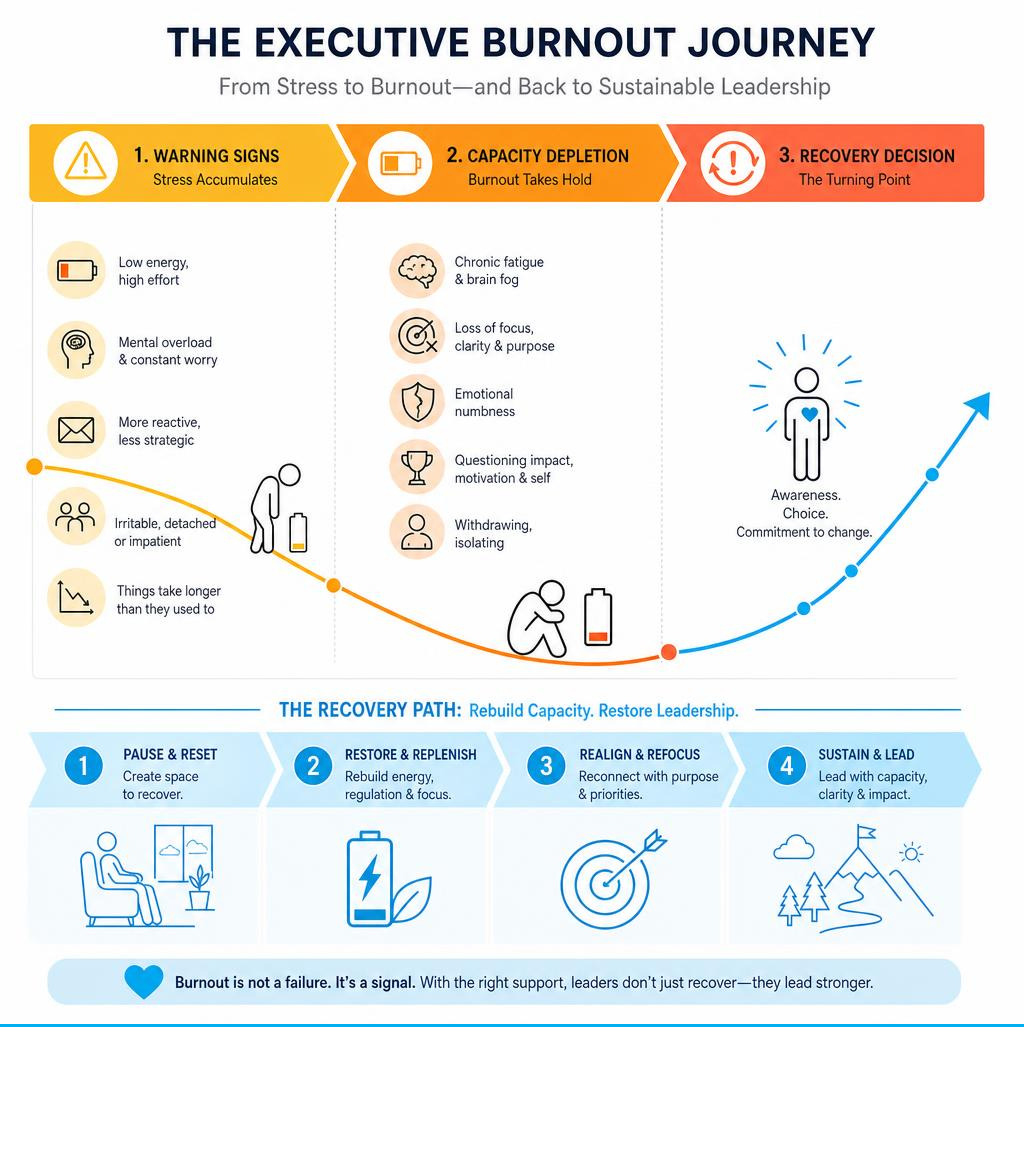
Recognizing the Silent Crisis: Early Warning Signs and Modern Drivers of Executive Burnout
The World Health Organization (WHO) officially classified burnout as an occupational phenomenon in the ICD-11, defining it not as a medical condition, but as a syndrome conceptualized as resulting from chronic workplace stress that has not been successfully managed. For senior leaders, this is rarely about working long hours alone. It is about carrying a compounding weight of responsibility in isolation.
At our East Hanover, New Jersey practice, we find that leaders often misinterpret their own burnout. They mistake a fundamental erosion of capacity for a sudden loss of “edge” or performance discipline. They try to push harder, which only accelerates the depletion.
To prevent this downward spiral, we must learn to distinguish between high-pressure executive stress and actual burnout risk.
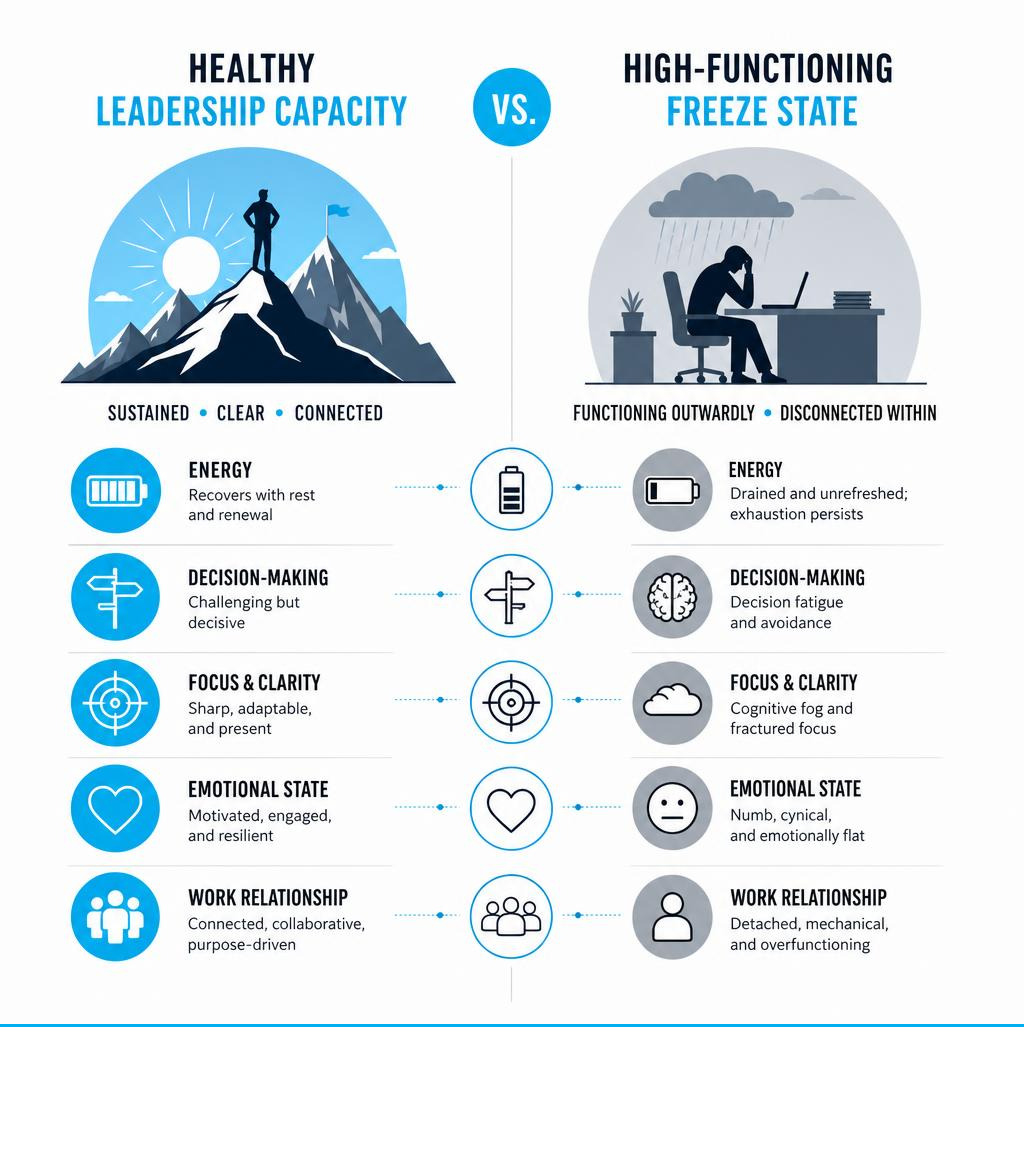
| Aspect | Normal Executive Stress | Clinical Burnout Risk |
|---|---|---|
| Energy Recovery | Restored after a weekend or vacation | Unaffected by time off; constant exhaustion |
| Decision-Making | Challenging but decisive | Severe decision fatigue and avoidance |
| Focus & Clarity | Occasional distraction under pressure | Persistent cognitive fog and fractured focus |
| Emotional State | Motivated, reactive to specific events | Flat affect, cynicism, and emotional withdrawal |
| Work Relationship | Engaged with strategic goals | Detached, mechanical, and overfunctioning |
The High-Functioning Freeze: Early Warning Signs Leaders Miss
One of the most insidious ways burnout manifests in high-achievers is through what psychologists call a “high-functioning freeze” state. On the outside, the executive appears to be executing tasks, attending meetings, and hitting targets. Internally, however, they are operating in survival mode—feeling numb, disconnected, and hollow.
This state is characterized by several key warning signs:
- Flat Affect and Emotional Withdrawal: A noticeable decline in empathy and emotional resonance. The leader struggle to connect with their team, showing a muted response to both wins and crises. This directly damages emotional intelligence in leadership, which is vital for maintaining trust.
- Sunday Dread and Over-scheduling: Experiencing intense anxiety before the workweek begins, countered by over-scheduling calendars as a defense mechanism to avoid quiet moments of reflection.
- Cognitive Fog and Performance Cost: Decisions that used to take minutes now take hours. The leader relies heavily on raw discipline rather than creative strategy, achieving results at an unsustainably high energetic cost.
When 77% of professionals in the U.S. report feeling burnout at work, leaders must recognize that they are not immune to these systemic pressures.
Why Traditional Methods Fail and the Rise of Executive Burnout Coaching
When an executive realizes something is wrong, their default response is often to seek traditional executive coaching or implement basic time-management hacks. However, traditional coaching is built on an assumption that the client possesses the underlying capacity to execute new strategies. It focuses primarily on skills, strategy, and intellectual change.
But you cannot think your way out of a physiological depletion.
Traditional coaching fails to solve burnout because it leaves the nervous system unaddressed. It treats the problem as an intellectual puzzle rather than a whole-system breakdown. This is where specialized executive burnout coaching diverges. By focusing on capacity rebuilding rather than simply managing time, it helps leaders close energy leaks and establish sustainable execution rhythms. The data supports this specialized approach: a landmark clinical trial demonstrated that three months of biweekly coaching significantly reduced burnout symptoms. Rebuilding this foundational capacity is one of the most critical benefits of executive coaching in today’s high-pressure corporate landscape.
Identity Fatigue and AI-Driven Workplace Changes in 2026
In May 2026, the executive landscape is more complex than ever. The rapid adoption of AI and continuous digital transformation have accelerated the pace of business, creating an expectation of constant availability. Leaders are no longer just managing operations; they are navigating constant labor disruptions and organizational restructuring.
This environment fuels what we call identity-performance fusion—a state where a leader’s self-worth is entirely tied to their professional output. When the workplace is in constant flux, maintaining this fusion leads to profound identity fatigue. Leaders feel they must be “always on” to prove their value, leaving no room for recovery. This dynamic is a primary driver of executive failure, highlighting the delicate relationship between executive coaching: leaders, power & failure.
Preventing Burnout Through Executive Burnout Coaching and Capacity Rebuilding

Preventing burnout requires shifting the focus from “doing less” to “rebuilding capacity.” True capacity is not about time management; it is about managing energy, cognitive load, and nervous system regulation.
Rebuilding Capacity: How Executive Burnout Coaching Restores the Nervous System
Our coaching methodology targets the physiological and psychological root causes of burnout. We work with leaders to regulate their nervous systems, moving them out of a chronic fight-or-flight or high-functioning freeze state and back into a state of safety and clarity.
To rebuild capacity, we focus on four primary pillars:
- Identifying Energy Leaks: Pinpointing the relationships, tasks, and systemic mismatches that drain energy without delivering return.
- Reducing Cognitive Load: Streamlining decision-making processes, closing open mental loops, and eliminating unnecessary micro-decisions.
- Establishing Recovery Anchors: Introducing non-negotiable daily and weekly recovery practices that restore physiological balance.
- Creating a Sustainable Execution Rhythm: Designing a leadership model that prioritizes deep work blocks, strategic pauses, and clear boundaries.
By restoring neurological safety, leaders can step out of survival mode and build confidence in leadership once again, leading with intention rather than reactivity.
Teaching Managers to Coach: Distributing Cognitive Load and Building Leadership Pipelines
A major driver of executive burnout is the dramatic increase in manager-to-worker ratios over the last decade. Leaders are managing more direct reports than ever, leaving them buried under a mountain of micro-decisions.
A highly effective strategy to mitigate this pressure is shifting leadership styles from “boss” to “coach.”
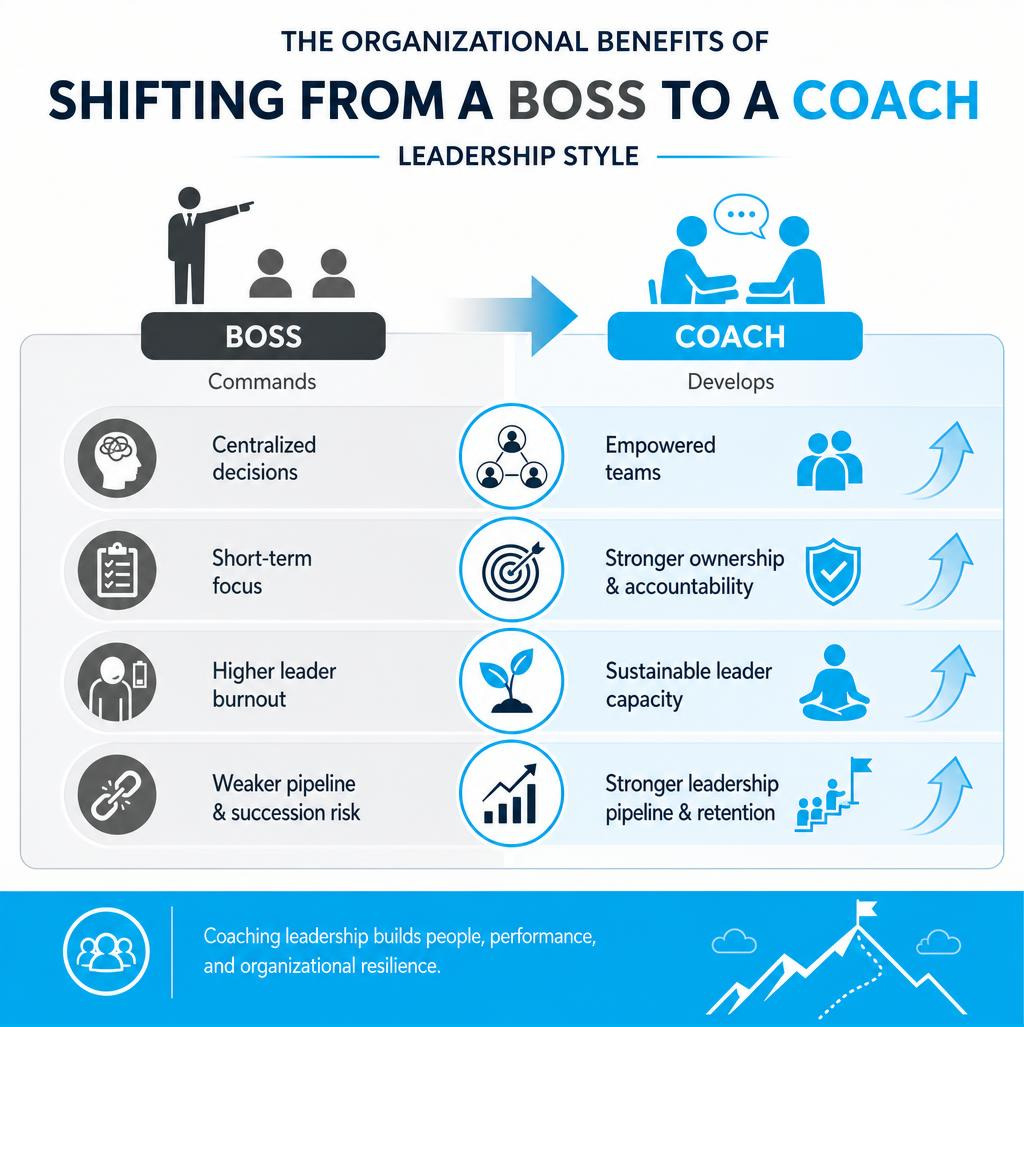
When executives learn to coach their own teams, they distribute the cognitive load. Instead of telling people what to do—which is exhausting and bottleneck-inducing—they ask powerful questions that empower managers to find their own solutions. This shift not only relieves the executive’s mental burden but also builds robust leadership pipelines and strengthens succession planning. By investing in leadership coaching: unlock potential across the organization, companies build systemic resilience that prevents burnout from cascading down the ranks.
When to Choose Burnout Coaching vs. Therapy or Succession Planning
As an executive or HR leader, it is critical to know when to deploy different interventions. While executive burnout coaching is highly effective for restoring capacity and redesigning leadership styles, it is not a cure-all.
- Choose Clinical Therapy: When the leader is experiencing clinical depression, clinical anxiety, or deep-seated trauma that requires psychological treatment.
- Choose Succession Planning & Career Transitions: When there is an irreconcilable value mismatch between the leader and the organization, or when the leader has decided to pivot away from their current path.
- Choose Executive Burnout Coaching: When a capable leader is depleted, struggling with decision fatigue, or operating in a high-functioning freeze, but is committed to rebuilding their leadership presence sustainably.
At Strategy People Culture, LLC, we understand these nuances. Led by Andrew Botwin’s 25+ years of experience, our East Hanover, New Jersey-based practice integrates coaching, HR consulting, and leadership training to help organizations navigate these exact challenges. We support leaders through the executive coaching: critical CEO journey, ensuring they have the capacity to drive business success without sacrificing their well-being.
If you or a leader on your team is performing at an unsustainable cost, explore our services: executive leadership coaching to learn how we can help you rebuild capacity, protect your leadership pipeline, and foster a resilient organizational culture.