
A Practical Guide to Implementing Leadership Accountability
Why Leadership Accountability Matters More Than Ever
Leadership accountability is when leaders take full ownership of their decisions, actions, and results—accepting responsibility for both successes and failures. It’s the foundation of trust, high performance, and sustainable business growth.
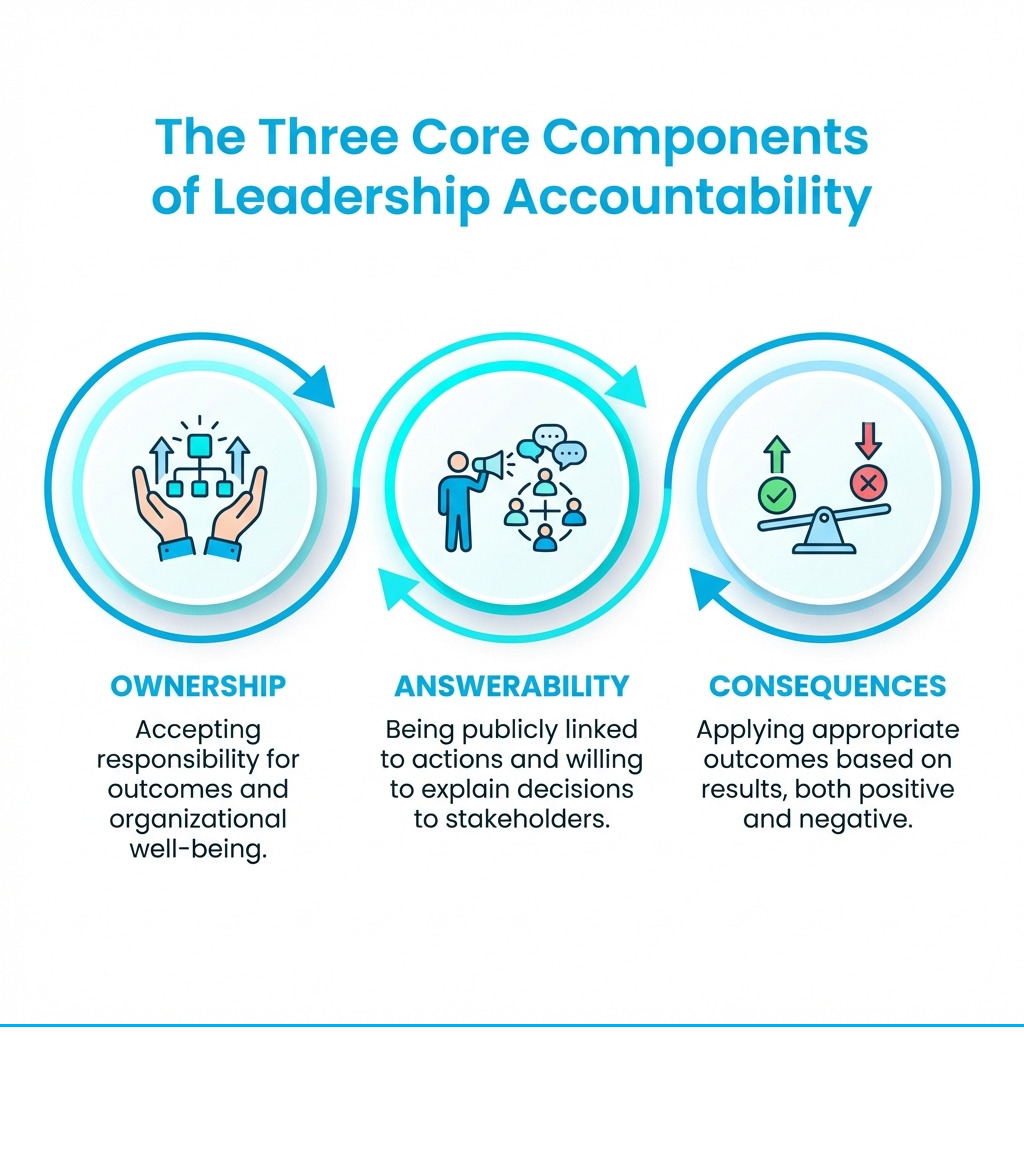
Key components include:
- Ownership – Taking responsibility for outcomes, not just tasks
- Transparency – Being open about decisions, progress, and mistakes
- Answerability – Willingly explaining actions to stakeholders
- Consequences – Accepting and applying outcomes based on results
- Commitment – Following through on promises and organizational goals
While 84% of survey respondents believe leader behavior is the top factor influencing accountability, it remains a top neglected behavior among managers. This gap creates high turnover, low trust, and missed goals.
When leaders model accountability, they set a standard that cascades throughout the organization, driving measurable business results. In fact, people at high-trust companies report significantly less stress, burnout, and sick days alongside much higher levels of energy, productivity, engagement, and life satisfaction. Organizations with strong leadership accountability outperform peers, retain talent, and foster innovation.
However, implementing accountability is hard. It requires clear frameworks, self-reflection, and a willingness to change.
I’m Andrew Botwin, and I’ve spent my career helping leadership teams build accountable, high-performing cultures. Through executive coaching and helping leaders resolve complex workplace challenges, I’ve seen how leadership accountability transforms organizations when implemented systematically and authentically.
The Foundation: Defining Leadership Accountability and Its Impact

Accountability vs. Responsibility: A Critical Distinction for Leaders
Often, the terms “accountability” and “responsibility” are used interchangeably, but understanding their distinct meanings is crucial for effective leadership accountability.
Responsibility is the duty to perform a task. It’s about what you do. For example, a leader is responsible for delegating project tasks. As we explore in our article on Delegation in Leadership, assigning responsibility is a key management step.
Accountability, on the other hand, is the obligation to answer for the results. It’s about owning the outcome—positive or negative. When we talk about leadership accountability, we mean leaders accept ownership for their decisions and those of their team. A team member might be responsible for a report, but the leader is accountable for its quality and business impact. Our blog post on Responsibility vs. Accountability vs. Ownership digs deeper into these nuances.
Here’s a simple breakdown of the differences:
| Attribute | Responsibility | Accountability | Ownership |
|---|---|---|---|
| Focus | Tasks, duties, actions | Outcomes, results, consequences | Personal stake, ultimate success/failure |
| Mindset | “I need to do this.” | “I will answer for this.” | “This is mine to make happen.” |
| Scope | Individual contribution to a task | Explaining and justifying actions/results | Deep commitment to the overall goal and its impact |
| Timing | Before and during task execution | After task completion, reviewing outcomes | Continuous, from inception to completion |
| Delegation | Can be delegated | Cannot be fully delegated (leader retains ultimate accountability) | Cannot be delegated |
The Importance of Leadership Accountability for Organizational Success
Why is leadership accountability so crucial? Its impact resonates across the entire organization.
First, it builds trust. When leaders own their decisions and outcomes, it fosters an environment of honesty and integrity. This transparency is essential for establishing credibility and allows people to acknowledge mistakes without fear of blame.
Second, it drives higher performance. Accountable leaders set clear goals, aligning team efforts with strategic objectives. This focus eliminates distracting activities and boosts productivity. Research has shown that accountability is a key factor driving positive work-related outcomes.
Third, it boosts employee engagement. When employees see leaders taking ownership, they feel more respected and empowered to take ownership of their own work. This is especially relevant as younger generations in the workforce seek to work for organizations that demonstrate accountability for their broader impact.
Finally, a lack of accountability has severe consequences, including low morale, high turnover, and unmet goals. Turnover is higher in low-trust organizations, leading to confusion and apathy. Conversely, people at high-trust companies report significantly less stress, burnout, and sick days alongside much higher levels of energy, productivity, engagement, and life satisfaction. This trust is also linked to better financial performance, with revenue growth tied to higher levels of trust.
Leadership accountability is not just a moral imperative; it’s a strategic necessity and a cornerstone of Good Leadership.
A Practical Framework for Implementing Leadership Accountability
Key Behaviors: How to Model Accountability as a Leader
For leadership accountability to truly thrive, leaders must actively model it through their own behaviors. These are the traits that distinguish accountable leaders:
- Taking Ownership of Outcomes: Accept full responsibility for results, good or bad. Give credit to the team for successes and take personal responsibility for failures. Don’t blame others or external factors.
- Admitting Mistakes Without Blame: Frame errors as learning opportunities. Be transparent about your own mistakes and focus on solutions, not blame, to foster a growth mindset.
- Leading by Example: Demonstrate integrity and commitment in your daily work. This includes meeting deadlines, following through on promises, and upholding ethical standards.
- Self-Reflection: Regularly assess your decisions and leadership impact. Ask, “What was it about my leadership that produced these results?” This introspection drives continuous improvement. Our article on Conviction & Reflection: Leadership highlights the importance of this trait.
- Proactive Problem-Solving: Anticipate challenges and work with your team to find solutions before problems escalate.
- Effective Communication: Ensure clarity in expectations and purpose. Communicate openly and frequently so everyone understands their role and goals. We explore the vital role of communication in our piece on 5 Leadership Values to Success.

Building the System: Fostering a Culture of Accountability
Modeling leadership accountability is the first step; the next is building a system that fosters it throughout the organization.
Setting Clear Expectations and Measurable Goals: Vague expectations lead to vague results. Use frameworks like Objectives and Key Results (OKRs) to provide structure and transparency. Set goals in an “X to Y by When” format for clarity.
The 5 C’s Framework for Team Accountability: To build team accountability, we use the “5 C’s” framework, detailed in The Five C’s of Team Accountability:
- Common Purpose: Explain the “why” behind tasks.
- Clear Expectations: Define what needs to be done, by whom, and when.
- Communication & Alignment: Keep the team focused through repeated communication. Effective Communication in Leadership is paramount here.
- Coaching & Collaboration: Monitor progress, provide support, and adjust as needed.
- Consequences: Apply appropriate outcomes, celebrating success and learning from mistakes.
Consistent Communication and Feedback Mechanisms:
- Regular Check-ins: Implement a “cadence of accountability” through brief, regular team meetings to focus on progress, commitments, and impact.
- Feedback Loops: Foster a two-way feedback culture where leaders provide honest, ongoing feedback and actively seek it.
Encouraging Ownership and Self-Reflection:
- Empowerment: Empower employees to track their own progress and involve them in decision-making.
- Growth Mindset: Cultivate a culture where mistakes are viewed as learning opportunities, not failures.
Recognizing and Rewarding Accountable Behavior:
- Public Recognition: Publicly acknowledge individuals and teams who demonstrate strong accountability.
- Linking to Performance Reviews: Ensure accountability is a key metric in performance evaluations and career progression.
Here are some powerful questions we use for accountability check-ins:
- What is the most important thing you can do this week to impact our goal?
- Did you meet last week’s commitments?
- How did those actions move our key metrics?
- What challenges are you facing, and how can I support you?
Overcoming Common Challenges in Leadership Accountability
Implementing and maintaining robust leadership accountability isn’t without its problems. Here’s how to steer them:
- Balancing Accountability with Empathy: A common misconception is that accountability and empathy are mutually exclusive. A study by the Society for Human Resource Management shows effective leaders embrace both accountability and empathy. Hold people to clear standards while also providing support and understanding.
- Avoiding a Blame Culture: Shift the focus from “who is to blame?” to “what can we learn?” A culture of honesty allows people to acknowledge mistakes without fear. Creating Psychological Safety at Work is vital in this regard.
- Overcoming Fear of Failure: Foster a growth mindset where calculated risks are encouraged. Show that it’s okay to fail as long as the team learns from it.
- Ensuring Consistent Application: Inconsistency erodes trust. Accountability standards must apply fairly to everyone, including senior leadership. This is one of the 7 Workplace Leadership Challenges we help leaders steer.
- Taking on Too Much Responsibility (Micromanagement): True leadership accountability means empowering others, providing clear guidance, and then trusting them to perform—not doing the work for them.
- Lack of Clear Goals and Expectations: If goals are vague, accountability is impossible. Many employees report not being sure what their organizations are trying to achieve. Leaders must clarify objectives and ensure everyone understands their role.
Conclusion: Lift Your Impact with Accountable Leadership
In this guide, we’ve explored the profound impact of leadership accountability, defining it not just as taking responsibility for actions, but for outcomes, and distinguishing it from mere responsibility. We’ve seen how it’s the bedrock of trust, high performance, and employee engagement, driving organizational success and fostering a culture where innovation can truly thrive.
We’ve outlined the key behaviors that define an accountable leader—ownership, integrity, self-reflection, and proactive problem-solving—and provided a practical framework for embedding accountability into your organization’s DNA. From setting clear, measurable goals using OKRs, to leveraging the 5 C’s of team accountability, and utilizing consistent communication and feedback mechanisms, the path to a more accountable culture is clear. We also addressed common challenges, emphasizing the crucial balance between accountability and empathy, and the importance of moving beyond a blame culture.
Strong leadership accountability lifts not only individual leaders but entire organizations. It empowers teams, builds resilience, and drives sustained results. As Andrew Botwin often says, “When leaders are truly accountable, they don’t just achieve goals; they inspire a movement within their organization.”
For leaders in New Jersey and beyond, cultivating this level of accountability is an ongoing journey of learning and development. If you’re looking to improve your leadership accountability, foster a high-performing culture, or steer complex workplace challenges, we at Strategy People Culture, LLC are here to help. With 30+ years of experience, we integrate coaching, team development, and training to foster awareness and success for both people and business.

Ready to transform your leadership and build a more accountable, high-performing team? Learn more about our executive leadership coaching services, then schedule a free consultation session to discuss your goals.
